

The Rise Of The Anti-System Moderate
Middle of the road institutionalists are positioning themselves as anti-system fighters ahead of 2028. Will it be enough to win over primary voters?


Beyond all else, the defining narrative of this Democratic primary cycle has been the emergence of progressive anti-establishment Davids running strongly against—and often defeating—more moderate establishment Goliaths. But as primary season approaches its end, is that narrative proving a false juxtaposition?
Several Democratic 2028 hopefuls sure hope so.
Whether it was Zohran Mamdani against Andrew Cuomo last year, Graham Platner against Janet Mills this Spring, or Abdul El-Sayed against Haley Stevens this summer, the story was the same: the progressive upstart rose from relative obscurity to massive grassroots popularity through creative campaigning and endorsements from progressive champions like Bernie Sanders and AOC. And despite being massively outspent by their more moderate opponents, who had both big establishment money and big name endorsements behind them, on election night the voters sent a message: The same old establishment playbook wasn’t going to fly this year.
This dynamic between the center and the left, and between defenders of the status quo versus anti-system changemakers, had grown into a full-fledged factional dispute among Democratic base voters, with some even pledging not to support the ultimate Democratic nominee in November.
But now that the establishment successfully struck back on Tuesday with a last minute hail Mary, locking in establishment pick David Crowley as the Democratic nominee for Governor of Wisconsin, that rift may be closing, even as the true narrative of the primary season comes more clearly into focus.
As The AP put it yesterday,
Forget left vs. center. Democratic voters are making clear they just want change.
Several of the 2028 Democratic hopefuls have been taking notes and are betting that being the candidate railing against the status quo while being ideologically middle-of-the-road—and even a part of the dreaded establishment—are not mutually exclusive.
As the 2028 presidential primary season draws ever nearer, several Democrats are already positioning themselves as Goldilocks candidates, merging both these qualities in the hope that 2028 is the year of the “anti-system moderate.”
Reformers Rising
For much of the Trump 2.0 era, Democrats have been undergoing an identity crisis. After Trump’s second presidential victory—this time bolstered by a popular vote win—along with the U.S. House and Senate both in Republican hands, Democrats were officially in the wilderness. The vibes were against them, the power was against them, and the people seemed to be against them.
When Trump was sworn in on January 20, 2025, his approval rating was actually above water, just above 50%. Democratic leadership and many Democrats in elected office simply did not know how to respond to Trump’s unconstrained corruption and authoritarianism. As a result, Democratic voters made them pay at the ballot box when they got the chance. For the past year and a half, Democratic voters everywhere have sent a very clear message to the Democratic Party establishment: no concessions, no business as usual, it’s time to step up and fight.
Some Democrats were happy to oblige. Governor Gavin Newsom (D-CA) and Governor JB Pritzker (D-IL) in particular adopted combative stances against Trump’s policies, notably his deployment of National Guard troops to their states, and in Newsom’s case, Trump’s mid-decade redistricting scheme.
But it wasn’t just opposition to Trump and Republicans that Democrats were craving. There was a palpable anger at the Democratic Party itself. As I wrote back in May of last year, Democratic presidential aspirants by then were already in the midst of their “path forward primary,” trying to best position themselves to respond to the mood of the Democratic primary electorate. Of the three buckets of leadership style I identified—the messengers, the fighters, and the reformers—in retrospect, it appears the reformers were the closest to truly understanding what the voters wanted.
But could sitting elected Democrats, members of the very establishment the base was revolting against, credibly convey such an anti-system message? And perhaps more importantly, could candidates who were seen as well within the ideological mainstream, i.e., normie center-left Democrats, appeal to an electorate increasingly enamored by leftist candidates?
After Tuesday’s Wisconsin results, it appears the answer is yes. As Democratic strategist Lis Smith put it to The AP,
“The through line between these races isn’t ideology. It’s impatience with this political system that feels disconnected from the urgency voters feel. The demand for change is much broader than the demand for socialism.”
Increasingly, it appears several top-tier Democratic hopefuls understand this, as they work to cast themselves as the change Democratic voters are looking for.
The “Established Insurgents”
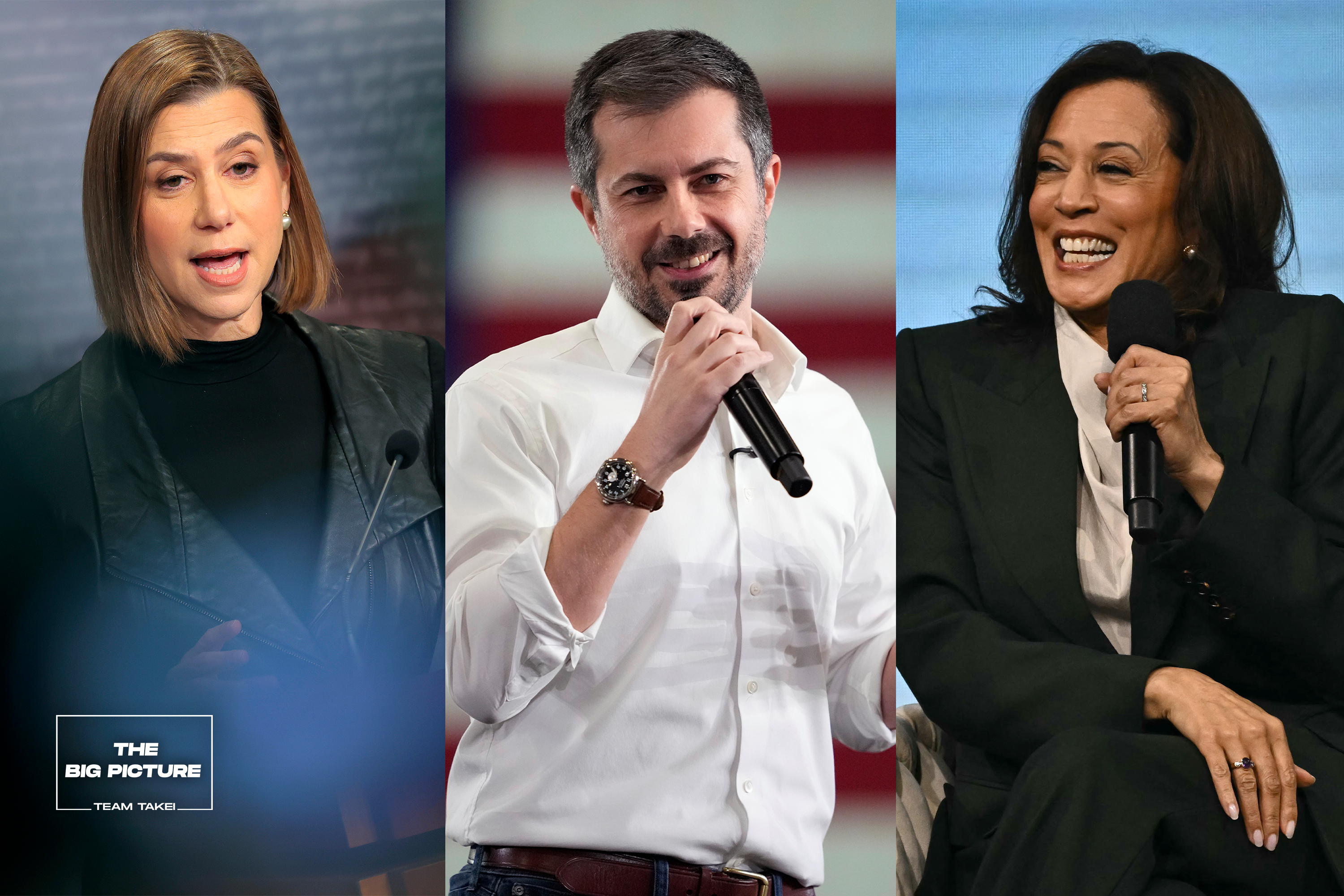
Senator Elissa Slotkin (D-MI) was early to understand that deep reform of the party was needed to ensure Democrats continue to win presidential elections into the future. Last Spring, mere months into her first term as U.S. Senator, Slotkin launched her “war plan” to fight Trump and return Democrats to power. Slotkin sees herself very much as a Midwest whisperer for Democrats, diagnosing part of the problem that voters in the middle of the country see Democrats as “weak and woke.” Now, a year later, even Rep. Alexandria Ocasio-Cortez appears to agree, recently saying, “Woke 1.0 was crazy.”
As of earlier this month, Politico caught back up with Slotkin to gauge her take on the 2026 primary cycle. And once again, her diagnosis appears on point:
For Slotkin, the distinction between progressives and moderates isn’t as important as the distinction between Democrats with mealymouthed messages and those with big plans that will signal serious change to voters. “The messages coming out of people — Democrat, Republican, independent — are basically, ‘We want new leadership, period, and we want bold ideas,’” Slotkin said. “And I think there’s a vacuum of that, and what you see are people on the further left of the spectrum filling that. And I don’t begrudge them. They’re responding to an across-the-board general desire. Now, that’s not to say when I go to Kansas that any individual says, ‘I want to be a socialist.’”
Now other Democratic 2028 hopefuls are heeding that same message, trying to walk a fine line between being a part of the establishment yet still claiming the mantle of reform.
As Gavin Newsom put it recently to reporters as he campaigned for Democrats in Michigan:
“I think this notion of insurgency over incumbency is the real message here, and people just want fighters that want people with conviction, strength, clarity. People that get it, want to get things done, and they’re done with the status quo.”
“I totally respect that,” Newsom added. “I long felt like I’ve been an established insurgent. I’ve always had that mindset.”
Kamala Harris struck a similar chord in a recent speech, arguing Democrats need to change their style of leadership and get comfortable with a certain level of “uncompromising” “ruthlessness” to combat the “broken status quo.”
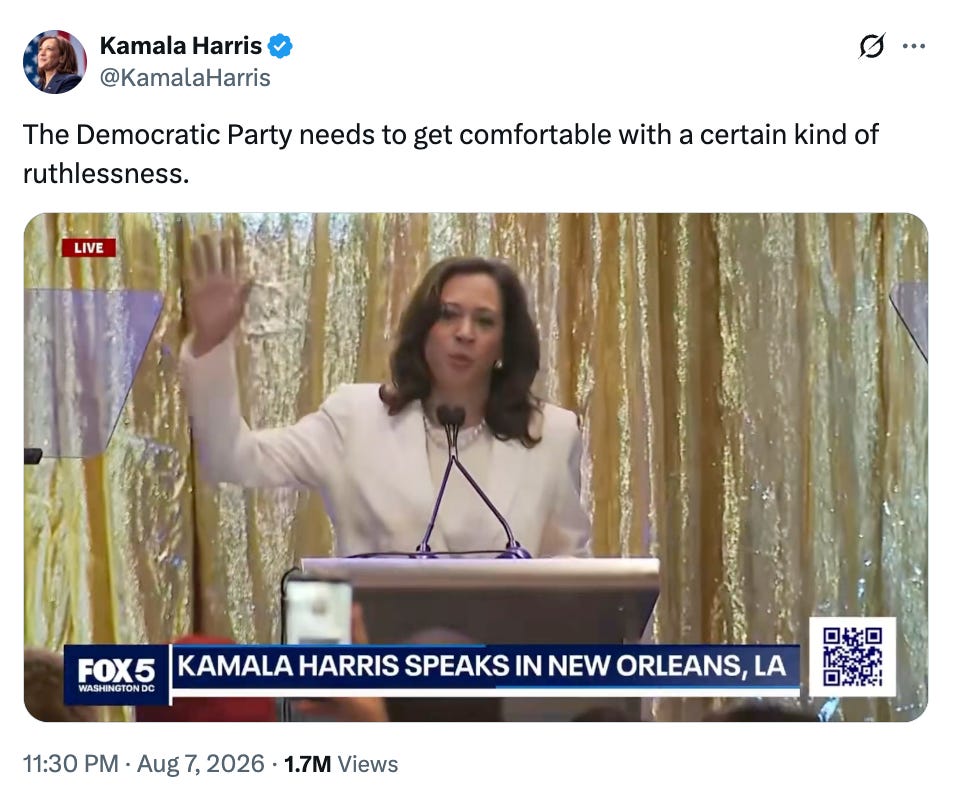
Harris also recently came out explicitly for expanding the Supreme Court to 13 justices and has sought to portray herself as a commonsense reformer.
“We’ll also need to look in the mirror and hold ourselves accountable. Government has to earn the trust of the people,” Harris will say. “And that means responding to the actual needs of the people—not with bureaucracy, but with speed and transparency. Not with process — but with progress.”
That sounds an awful lot like another Democrat who has sparked presidential buzz, appearing near the top of any list of 2028 hopefuls: Pete Buttigieg.
Buttigieg has lain relatively low since leaving the Biden administration last year, traveling the country holding town halls, largely in red states and districts. As someone with a reputation for being a middle-of-the-road institutionalist, Buttigieg has cultivated a reputation for going into spaces that are typically hostile to Democrats and making eloquent, often viral arguments for why the Democratic Party has the better set of values and agenda for moving the country forward.
But listen to him lately and there is a distinct anti-establishment tenor to his remarks, recalling some of the candidates who have been winning primaries this year.
In a June interview with NOTUS, Buttigieg said running the Department of Transportation “radicalized him.” Elaborating, Buttigieg explained,
It showed me the need for institutional change. I’m an ideological moderate, but when it comes to our institutions, I think that what I saw was just how hard it was to get even common-sense things done. How many layers of bureaucracy delayed the delivery of a new bridge or airport?
Additionally, Buttigieg is insistent that, unlike in 2020, Democrats not run on a “return to normalcy” agenda despite every instinct of Democratic Party institutions to want to return to some fictional previous ideal time in the past.
I believe very strongly that there’s no going back. It is not possible, or even desirable, to try to restore a previous status quo. Obviously, a lot of the things that are going on right now are terrible, and in my view, some of them are criminal. That doesn’t mean the right answer is to just pick up the pieces and have what we used to have. Because the flaws of our economic and social and financial and political status quo from before, I think, helped to explain what got us into the mess we’re in right now.
Buttigieg reiterated this during a recent sit-down with Jonathan Martin for Politico, and explicity addressed the notion of whether an ideological moderate could in fact also be the champion of bold reforms.
But to me, the most important thing is — are we demonstrating a readiness to be focused on building what’s next or are we basically preaching some version of “return to normal”? “Return to normal,” in my view, won’t work. One way to say I’m not a “return to normal” is to present the idea that looks furthest left, because that makes you, in a certain way, seem bold. I don’t think it’s the only way to be bold. And so, I think it is really important to not let it lapse into a “left versus center” thing, when the most important question to me is, are we gonna try to sell some version of a previous status quo?
There’s a risk that there’s an unspoken Democratic assumption that we’re trying to take us back to … I don’t know what, is it 2012, is it 1992, is it 2021? Whatever it is, we can’t go there. We shouldn’t try, we shouldn’t want to.
All four of these Democratic hopefuls are banking that anti-status quo reform messaging will serve as a proxy for whatever ideological leftism Democratic voters may be craving. Because, as we saw in 2024, Kamala Harris was widely perceived by voters as more extreme than Donald Trump. Painful as it is to admit, Trump ran and won as the anti-system moderate of that cycle.
And new data confirms Democrats would be correct to emulate that strategy.
Reaching Anti-System Voters
In last week’s Michigan Senate primary, the anti-establishment progressive, Dr. Abdul El-Sayed, eked out a narrow win over the establishment moderate, Rep. Haley Stevens. But pollster G. Elliott Morris, in a new piece this week, warned readers not to fall into a narrative trap, writing, “people are largely missing the real story in the Democratic Party today.”
He went on:
The strongest predictor of individual perception of politicians, including El-Sayed and Zohran Mamdani, is not whether someone identifies as a progressive or a moderate, but whether they think the American system needs to be torn down and rebuilt.
These are the so-called “anti-system” voters I have written about before. The general gist is that there’s a group of voters out there who have very weak ideological attachments but very strong anti-system orientation. Donald Trump used this group to win the presidential elections of 2016 and 2024.
For politicians, whether on the left or more in the center, that anti-system sentiment can do a lot of heavy lifting, and it may just hold the key for how candidates can appeal to the left and the center of the Democratic Party in 2028.
As Morris explains:
A lot of political pundits are interpreting the divide in the Democratic Party right now as a left-vs-right divide. But as this data shows, it’s better understood as a divide over whether you think things in this country are generally OK or just merely “poor,” or whether you think the system needs fundamental changes. Those are not the same question, and the second one is currently doing a lot of work driving voting behavior in both primaries and the general election.
While Morris has found a direct correlation between anti-system candidates and their appeal among progressive voters, he notes that anti-system voters are not confined to the left.
Moderates who say they want “major, disruptive changes” to the political system (54% of moderates) are backing Democrats 69% to 14% in their local House races, while moderates who don’t (46%) are backing Republicans 61% to 24%.
These moderate voters are otherwise very similar — ideologically, demographically, and geographically. What’s driving their behavior is their anti-system orientation.
This has significant ramifications for what will comprise mainstream Democratic policy heading into the next presidential cycle. It is anti-system, for example, to oppose more funding for Israel, to oppose the use of dark money in politics, to fight for Medicare For All, and to support a wealth tax to pay for it.
Look at Peggy Flanagan’s massive victory over Angie Craig in Tuesday’s Minnesota U.S. Senate primary. Flanagan is the sitting Lieutenant Governor of the state, and very much a part of the establishment. Yet she was able to run and win on an economic populist message similar to El-Sayed in Michigan, focused on getting money out of politics and fighting for Medicare for All. These policies have the benefit of being both anti-system and broadly popular among leftists and moderates alike.
And among the potential Democratic 2028 hopefuls, Rep. Alexandria Ocasio-Cortez has been singing this tune for years. Small wonder that she consistently polls at or near the top of any 2028 Democratic preference survey.
The big question moving forward is this: How “anti-system” are these moderate politicians willing to go when it comes to setting the Democratic policy agenda for the 2028 presidential race and beyond?
Pay attention also to David Hogg and his group Leaders We Deserve. Their message is getting through to young and "old" voters. No more status quo, and for sure, no more going back.
Pete has not just been saying this "lately", Pete has been saying this since at least 2019.
Expand the Supreme Court, eliminate the Electoral College, get rid of the filibuster, shore up our democracy, all of this, and people (including Harris supporters) mocked him for it and called it platitudes. Now, 7 years later, everybody is saying it.
A staff member from Pete's 2020 campaign once said that Pete's curse was to be right about everything before people were ready to hear it. Sure looks like that now.