

Blundering Forward, Trump Style
Trump’s big policy mistakes follow a familiar pattern, and we should expect the same with the war in Iran.


The war in Iran, now in its 13th day, presents a painfully predictable example of how the Trump regime operates.
Like the tech bros who back it, the Trump White House likes to “move fast and break things.” But it consistently fails to offer coherent explanations for its actions or any plans to fix the mess it creates, in this instance a global oil supply crunch.
It thumbs its nose at our Constitution and our laws, which are designed to secure public support for going to war and to curb executive overreach.
It ignores both expert opinion and common sense, either one of which would have advised against forcing a strategically-located enemy like Iran into a war of attrition.
And if past is prologue, the regime will find someone else to blame for its forced retreat and humiliation while desperately spinning it as a win.
We have seen this pattern play out in three other major political blunders of his second term: the DOGE debacle, his “Liberation Day” tariffs, and the ICE surge in Minneapolis. It’s instructive to rewind and review how each policy disaster played out. While there’s no guarantee that the Iran war will wind up the same as his previous blunders, Trump is unable to be anything but his flawed self. This makes it all the more likely that Trump will try to sell a stinging Iran war defeat as a victory.
All this will happen just as the GOP works to shore up its chances of keeping the House majority in November’s midterm elections. But as with earlier blunders, the war will have alienated more voters, including some within Trump’s core base of support.
It’s a political self-own of Trumpian proportions.
DOGE ball
One of the very first actions of the White House was to appoint Elon Musk to lead an amorphous “government efficiency” group known broadly as DOGE. The story of that effort follows the pattern I described above:
1) move fast and break things,
2) thumb your nose at our Constitution and our laws,
3) ignore the experts and common sense,
4) retreat and blame someone other than Trump, and
5) sink Trump’s approval numbers.
The first big “move fast and break things” action by DOGE was, as Elon Musk gleefully described it, to put USAID through the woodchipper. His teams took over the agency’s systems and froze outbound payments to aid organizations and contractors while suspending all USAID employees. The overnight shock of that move caused ripple effects that left hundreds of thousands of refugees, sick children and starving populations around the world suddenly without support, resulting in hundreds of thousands of deaths.
The White House actually lacked the power to unilaterally impound congressionally authorized funds in this manner. The U.S. Constitution makes this clear in Article I, affirmed in 1975 when a unanimous Supreme Court in 1975 held in Train v. City of New York that then-President Nixon could not refuse to spend funds Congress had appropriated under the Clean Water Act. To drive the legal point home, Congress passed the Impoundment Control Act in 1975, requiring the President to notify Congress of any intent to rescind or defer appropriated funds and giving Congress the power to override such actions.
Allowing DOGE goons access to government systems in order to issue mass terminations, cancel “DEI” programs, kill research funding for science and medicine, and eliminate “fraud and waste” was a disaster in the making. Warnings were issued from both systems experts and anyone who understood that 22-year-old techies with names like “Big Balls” shouldn’t be given unfettered access to our sensitive, confidential systems. The fallout from these actions was brutal: the DOGE actions crippled federal agencies and set back science and research by years, all while failing to result in any meaningful cost savings. Meanwhile, the personal data of hundreds of millions of Americans appears to have been deeply compromised.
Musk became the hated face of DOGE, with Tesla boycotts cutting deep into sales while agency heads fumed at his unilateral destructive acts. Trump and Musk had an epic public spat and a falling out, and in the end DOGE was essentially disbanded. Its members are now being questioned under oath about their actions with some truly head-shaking revelations of their ineptitude and disturbing motivations, as in this moment during the recent deposition of DOGE member Justin Fox:
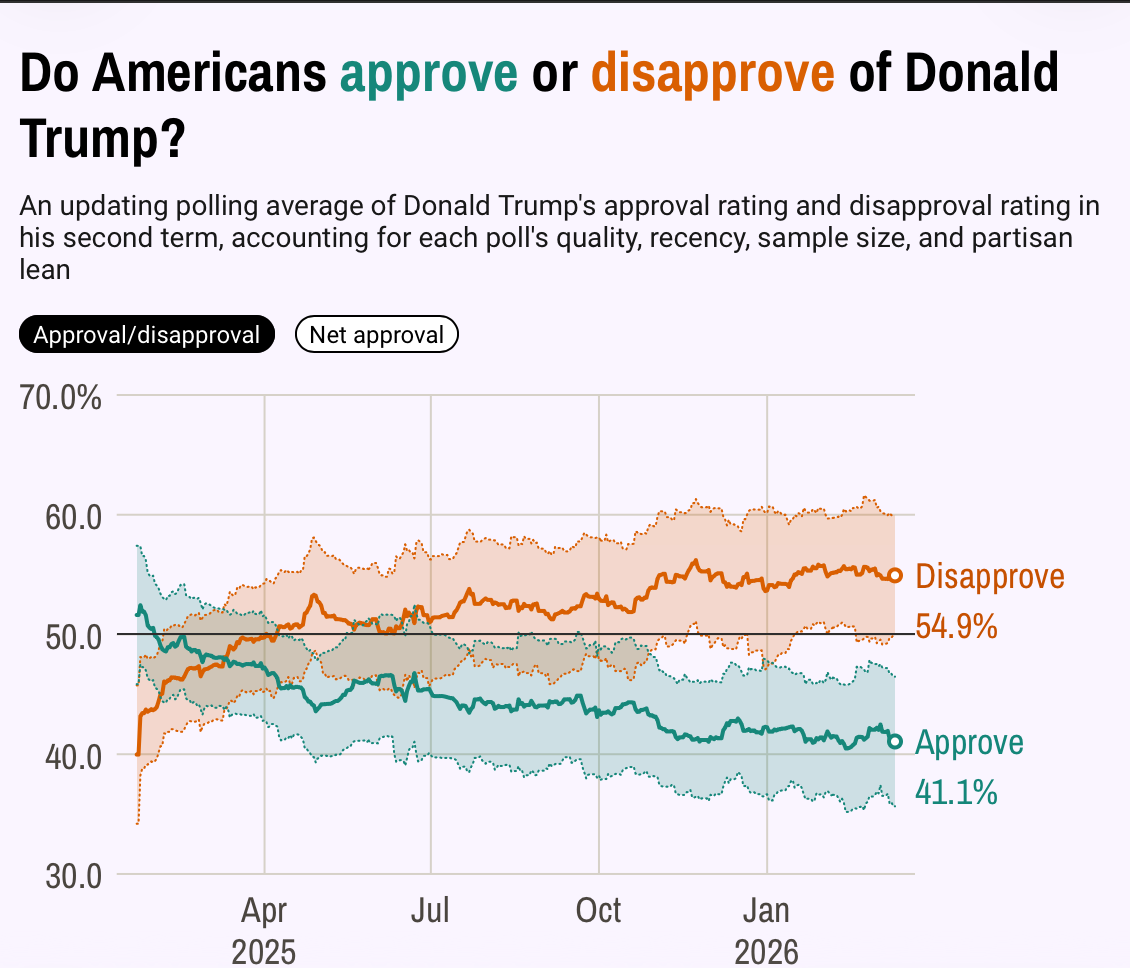
The political fallout for Trump over DOGE began to impact Trump’s approval ratings. Indeed, his approval numbers, based on polling averages, turned negative around this time last year, just as the public was becoming keenly aware of how much damage Trump’s unleashing of Musk and DOGE on the government had done.
No De-“Liberation Day”
Trump’s signature economic plan centered around raising tariffs on imported goods. He did it first with our major trading partners Canada, Mexico and China, and then with the rest of the world on April 2, 2025. It was the most sweeping tariff hike since the Smoot-Hawley Tariff Act of 1930.
The five-step Trump regime blunderbook played out exactly as expected here, too.
In typical Trump fashion, the tariffs were a hammer blow to global trade. This was his clear intent. Trump wanted to shake things up to demonstrate he was tough and unpredictable, all to force economic concessions from our trading partners. Overnight, the financial markets tanked and the cost of imported goods rose sharply, with the highest tariffs imposed on countries with large trade surpluses with the United States. Many goods that were already en route became wildly unaffordable for importers, while exporters scrambled to adjust to a new tariff regime that changed day to day. Many small U.S. businesses selling imported goods suddenly faced bankruptcy. Indeed, a survey of 2,392 small business owners conducted in May of 2025 showed that 20 percent feared they may have to shut down due to the trade war created by the tariffs, and half expected their revenue to decline.
Legally speaking, just as with DOGE, the White House didn’t care that its tariff actions lay outside its powers. The executive branch lacks the legal right to impose tariffs, unless it is authorized by law to do so. After all, tariffs are a tax upon imported goods, and under our Constitution only Congress has the power to levy them. Trump sought to get around this by declaring “national emergencies” on everything from non-existent fentanyl trafficking over our border with Canada to the trade deficit itself, which has been around for decades and is hardly a cognizable “emergency.”
Substantively speaking, economic experts warned that the tariffs would create inflation in the U.S. Even conservative economists warned that the tariffs would not cause manufacturing to relocate to the U.S., as Trump had declared would happen. Both of these predictions have proven true. Inflation, which had been coming down, ticked back up as importers passed along sudden higher costs to consumers. Meanwhile, manufacturers continued to close U.S. factories and relocate them to other countries, in part because imported inputs on manufacturing were now taxed at such high levels. The White House also ignored history and common sense: the Smoot-Hawley tariffs of the 1930s had deepened the economic crisis of the Great Depression, as any high school student who has read about that era knows, but Trump and his economic advisers somehow believed they could escape this same fate.
The blame game came next. In the end it was two of Trump’s own Supreme Court appointees, Justices Neil Gorsuch and Amy Coney Barrett, who helped form the 6-3 Supreme Court majority that struck down his tariffs. Trump was livid and immediately threw them under the bus for ruining his economic plans. He went after the two justices by name, calling them “fools and lapdogs for the RINOs and the radical left Democrats.” He even brought their families into it, saying they would be an “embarrassment” to them. In response to the Court’s ruling, Trump immediately levied a 15 percent across-the-board tariff that was also of dubious legality. But his power to use tariffs to bully specific trading partners now appears severely limited.
His poll numbers also tanked as a direct result of his tariff policies, losing him key support from independents. The public quickly came to understand who would actually bear the brunt of the tariffs’ cost. Following his “Liberation Day” announcement, a HarrisX poll of 1,883 registered voters, taken days after the announcement, showed Trump’s overall approval rating plunging five points. According to a Washington Post / Ipsos poll, taken in late February of this year, some two-thirds of Americans disapprove of his tariffs, versus only around a third who approve. Tellingly, while Trump maintains support for his tariffs policies from his GOP base, he is severely underwater with independents, with 72 percent of them disapproving of his tariff policies.
The ICE men cometh
After YouTuber Nick Sortor aired a highly misleading yet widely shared “exposé” on alleged child care fraud by Somali immigrants in Minneapolis, Trump and the Department of Homeland Security saw an opportunity to involve ICE in the policing of “fraud.” By demonizing that entire immigrant community, and by targeting the city at large for allowing such “fraud” to happen, they could punish Gov. Tim Walz, even while accustoming the American public to the idea of armed federal immigration agents on our nation’s streets and in our neighborhoods.
We all know by now that this didn’t go as planned. But following our five-step analysis, we can see more clearly why.
As it had before, the White House moved fast and broke things. The regime’s surge of immigration forces put more federal agents on the streets of Minneapolis than there were local police. The ICE and Border Patrol agents immediately began acting with impunity under the leadership of “Commander-at-Large” Greg Bovino, who treated Minneapolis as a war zone rather than a peaceful community. By having ICE and Border Patrol agents rove about in armed gangs, seizing suspected undocumented migrants and U.S. citizens alike, the regime believed it could quickly silence opposition and make an example of Minneapolis.
To achieve this effect, the Trump regime again had to violate constitutional and legal norms, particularly the Fourth Amendment’s protections against search and seizure. As the Associated Press first reported, lawyers inside DHS crafted a legal opinion that produced a secret memo, according to a whistleblower. It urged instructors to inform agents they could enter homes without a judicial warrant, instead relying solely upon an “administrative warrant” signed by an immigration judge. As tensions mounted and protests grew, federal agents routinely ignored engagement rules and put themselves in the paths of vehicles, later claiming that they feared for their own safety and justifying the use of force—in the case of Renee Good with deadly consequences.
After Good’s death, a popular uprising in Minneapolis against ICE grew to tens of thousands of protesters in the streets and an organized resistance to the roving gangs of immigration agents. Law enforcement experts warned that continued aggressive actions by armed ICE and Border Patrol agents would inevitably result in more civilian deaths. Indeed, Minneapolis Police Chief Brian O’Hara warned in a 60 Minutes interview that aired on January 19 that he had been “trying to get anyone in a position of authority to understand that tragedy was imminent” and that he feared there was going to be “another moment where it all explodes.” This tragically proved true just five days later when Border Patrol agents fired upon Alex Pretti.
The White House’s denial of what the whole nation could see—that Pretti had posed no danger to any agents and it was they who had acted unprovoked and violently toward him—was compounded by its quick labeling of him as a “domestic terrorist,” just as officials had done with Good following her murder by ICE agent Jonathan Ross. The political pressures soon proved too great, even for this regime, and someone had to take the fall. First it was Bovino, who was unceremoniously demoted and sent back to El Centro, California. Not long after that, his replacement, Border Czar Tom Homan, announced the end of the ICE surge in Minneapolis and began to draw down federal forces there. Recently, Homeland Security Secretary Kristi Noem also lost her job, becoming the first cabinet-level official to be fired in Trump’s second term, in part because of sharp differences between her and other agency leaders.
As with its other disastrous blunders, the White House’s ICE campaign in Minneapolis drove Trump’s poll numbers sharply lower, even on his signature issue of immigration enforcement that defined his 2024 presidential campaign. Polling by NBC taken this February shows a strong correlation between those numbers and the murders of U.S. citizens in Minneapolis, with “strong disapproval” of how Trump handled border security and immigration jumping from 38 percent last summer to 49 percent following the killings, and Trump’s overall approval rating declining to 39 percent in their aftermath.
Iran but didn’t get away
The same pattern is playing out in Iran.
Trump moved suddenly and unexpectedly to bomb Iran in the middle of negotiations, taking out key members of their political leadership. He thought this would go like Venezuela, with an easy removal of the president and a quick end to hostilities, but he and his advisors badly miscalculated.
In part that’s because they ignored the Constitution and the law, specifically the War Powers Resolution, which requires express congressional authorization for war. Such authorization would have required time for deliberation, emergency hearings, and public debate—all things that a healthy democracy should undertake before it commits itself to a war as consequential as this one.
Had he spoken to real experts, instead of listening to real estate moguls such as Jared Kushner and Steve Witkoff, perhaps Trump would have understood that Iran was prepared to fight an asymmetrical battle of attrition and no amount of bombing its forces would dislodge the regime. As Jonathan Last of The Bulwark noted, there was even a white paper from the U.S. Institute of Peace, written over a decade ago, about how Iran would not quickly capitulate, even if its leadership were destroyed. That’s because it had in place a “Mosaic plan” that would divide military decision-making among 31 independent regions. Iran has now executed that contingency plan. Those same experts, along with anyone with common sense, would have pointed out that a prolonged conflict in the Persian Gulf could threaten the world’s oil and liquid natural gas supplies, particularly if Iran closed the Strait of Hormuz as it has now done. The knock-on effects of this would be soaring prices for gasoline, fertilizer, jet fuel, heating fuel, and anything that requires shipment abroad.
If Trump acts as he has in the past, he will now seek a retreat from his epic error, even as he claims his primary goals were accomplished. That’s a hard point to make when those primary goals were never clear to begin with. It will be a doubly hard point to make as Iran steps up its drone attacks and keeps a fifth of the world’s oil from reaching its destination. To get there, Trump will need to find people to blame for this blunder, and there are already some prime candidates.
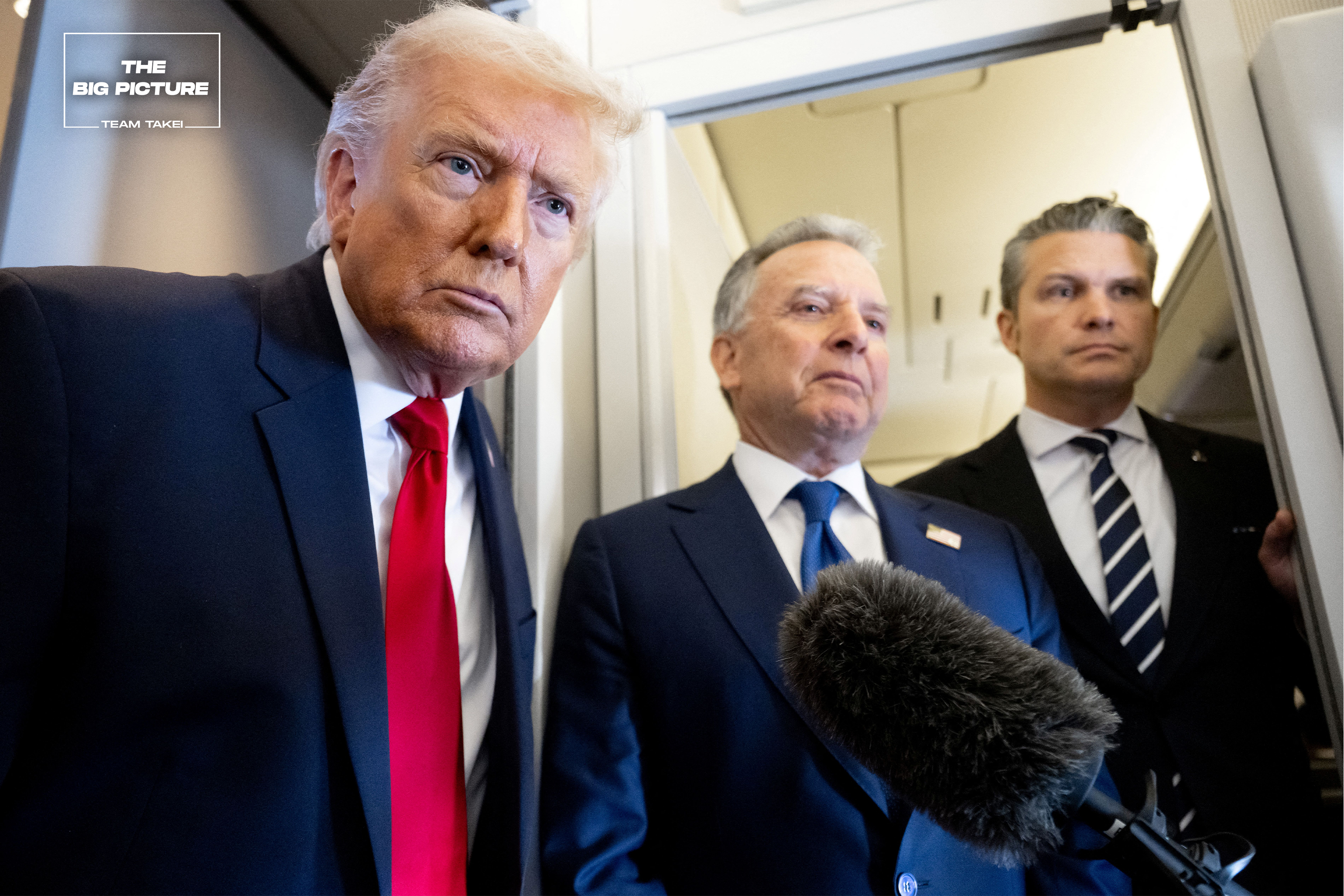
Trump told reporters that his decision to strike Iran was based on advice he heard not from his intelligence experts but from Kushner, Witkoff, Hegseth and Rubio:
In short, if you believe Trump, it was their advice of an imminent attack by Iran that caused him to pull the trigger on the attack. He was just going along with what they said!
If recent history is any guide, this would be a prime opportunity for Trump to finally get rid of Hegseth, who has seen an outsized share of scandals and whose leadership is, to put it mildly, not appreciated by the military brass. Like Noem before him, Hegseth is currently under fire for caring too much about his own brand and appearance (he recently barred press cameras from the Pentagon due to “unflattering photos” of him) and for misusing and wasting department’s funds, in this case blowing tens of millions of dollars on crab legs, lobster tails, fruit baskets and luxury goods for the Pentagon.
The war in Iran has become the final straw for many of his own die-hard supporters, many of whom feel misled into believing Trump was the “peace president” and wouldn’t embroil us into further wars, particularly in the Middle East. If the war drags on, and in particular if U.S. troops are deployed on the ground, Trump could see support collapse. According to a recent Quinnipiac poll, 74 percent of respondents oppose sending U.S. ground troops into Iran, including a majority of Republican respondents.
Trump finds himself very much in a bind as a result. In order to force Iran to allow oil to flow, and to find and destroy its remaining stockpile of nuclear grade weapons material, Trump will likely have to commit U.S. ground forces to the fight. That could mean far higher U.S. service member deaths and a plunge in popular support for his presidency.
But if he backs down and tries to claim victory, Iran may not let him do so. It could keep the Strait of Hormuz closed and remain in a state of war for an extended period as its military regroups and reorganizes despite continuous U.S. bombardment. It could continue to produce inexpensive drones and destroy container ships in the Persian Gulf. That could create a political disaster for Trump at home as prices for everything soar.
All this is to say, Trump moved too fast, didn’t consult Congress, ignored the experts (and common sense), and now needs an off-ramp and someone else to blame.
By now the pattern is unmistakable. And once again, the country will pay the price.
One correction. Not just this country will pay the price. The whole world is.
His pattern: me, me, me, me, me, ME!!!