

The Moderates Strike Back
The U.S. Senate race in Michigan is ground zero in the fight for the future of the Democratic Party


Ever since Donald Trump retook the presidency in January 2025, the left has largely been unified in opposition to a common foe. No matter where on the political left one fell, Trump and his MAGA movement, which were widely viewed as ascendant both politically and culturally after the 2024 election, posed clear existential threats to progress. This united front largely remained intact throughout 2025 as Democratic candidates overperformed in special elections around the country and as the fight to counter Trump’s mid-decade redistricting scheme became yet another point of unity.
But what appeared to be a united front obscured some real divisions that have been exposed in recent weeks. An intra-party battle is brewing between the far-left insurgent wing and the moderate establishment faction of the Democratic Party.
While there have been signs of a rising left throughout this year’s primaries, New York City’s June 23rd Democratic primary results proved to be a turning point. Two candidates backed by Mayor Zohran Mamdani and the Democratic Socialists of America (DSA) ousted sitting Democratic members of the House. This feat was repeated a week later when DSA-backed Melat Kiros defeated 15-term progressive Rep. Diana DeGette in Colorado’s 1st District by 13-points.
The fight to control the U.S. Senate is the latest battle, as the race for the Democratic nomination for an open Senate seat in Michigan has narrowed to a DSA-backed progressive endorsed by Bernie Sanders and AOC, and a moderate sitting member of the House backed by Chuck Schumer and AIPAC.
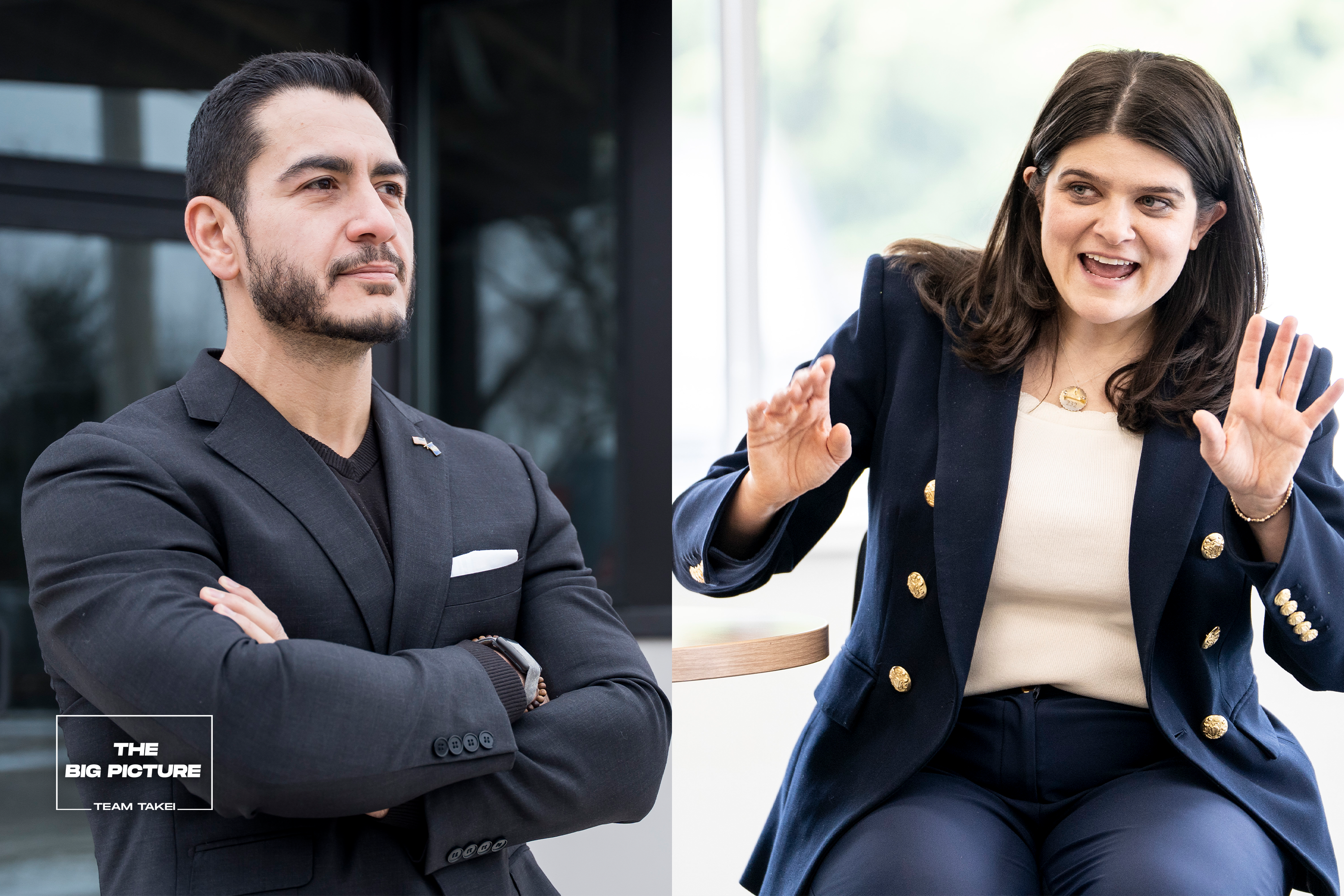
Indeed, a more perfect proxy battle between the two Democratic factions could hardly be scripted than in the race between Dr. Abdul El-Sayed and Rep. Haley Stevens in Michigan’s August 4th Senate primary.
And while the establishment may have been late to react to the brewing insurgency of the DSA-backed left, with control of the U.S. Senate on the line the moderates are striking back. But is it too little too late? And does it risk long-term damage that could threaten Democrats’ chances to retake control of Congress in November?
The Battle For Michigan’s Senate Seat
On Sunday, Michigan State Senator Mallory McMorrow, who was widely seen as a comfortable “middle ground” pick in the Michigan Senate primary, dropped her bid for the seat, after polling in a distant third place.
That left DSA-backed El-Sayed head-to-head against Rep. Stevens, battling it out in the final weeks of the campaign. Their first debate is slated for this evening, and absentee ballots are already in voters’ hands and being accepted by state election officials.
This race pits the two factions of the Democratic Party against each other in three important ways.
Anti-Establishment Insurgency
The story of the 2026 Democratic primaries thus far has been clear: Democrats have let the establishment know that the status quo is not acceptable. After Democratic Party leaders failed to halt the rise of Donald Trump, not once but twice, and then largely failed to effectively respond to the radical authoritarianism of his second term, Democratic voters want candidates who will shake up the system, not perpetuate it.
The first signs of this came last summer with Zohran Mamdani’s stunning primary win over Andrew Cuomo in the NYC mayoral race, and then with the emergence of Graham Platner in the Maine Senate race. Bernie Sanders’ endorsements of both of these young, anti-establishment insurgent candidates helped fuel their rise as champions for the working class against the oligarchic ruling elites and the political status quo.
By November, Mamdani dominated in the general election and Platner continued to catch fire in Maine, even amid multiple scandals. Ultimately, Senator Chuck Schumer recruited the popular sitting Governor of Maine, Janet Mills, to join the race as a check against an untested anti-establishment candidate. But in the anti-status quo change environment of 2026, Mills proved to be the exact wrong pick to blunt the rise of an insurgent challenger. Mills’s campaign fizzled, and she suspended her campaign. Platner won the primary decisively on June 9 with 72% of the vote.
With the recent credible accusation of sexual assault against Platner, his candidacy serves as a cautionary tale that more establishment-friendly moderates are already spinning as vindication. But this ignores the very real energy Platner inspired among base voters, which led him to receive the most votes ever in a Democratic primary in Maine’s history. It was this platform of passing Medicare for All, ending foreign wars, and championing workers over the wealthy and corporations that has fueled other insurgent campaigns all this year, particularly in deep blue House districts.
In the February 5th special election primary to fill Governor Mikie Sherrill’s House seat in NJ-11, AOC-backed activist Analilia Mejia narrowly defeated former Congressman Tom Malinowski for the seat. On May 19, AOC’s endorsement helped put Democratic Socialist state Rep. Chris Rabb over the top in Pennsylvania’s Third District. Then came the June 23rd earthquake in New York City, when all three of Zohran Mamdani’s DSA-backed candidates won against establishment-endorsed candidates, followed a week later by Melat Kiros’s stunning upset against Diana DeGette in Colorado’s 1st District.
Against this backdrop, the scene is set for the head-to-head match-up of the Sanders- and AOC-backed El-Sayed versus the Schumer-backed Stevens for the Democratic primary for U.S. Senate in Michigan. And from the arguments those who’ve endorsed Stevens are making, their central argument is clear:
Senator Chuck Schumer told Punch Bowl News:
“I think she has the best chance to win.”
Stevens herself said on X recently,
“If you want to flip the Senate, I’m your gal.”
A line she repeated here.
EMILY’s List said in their endorsement,
Haley is a proven fighter for Michigan workers and families — and the strongest candidate to hold this critical seat, defeat Mike Rogers, and deliver real results in the Senate.
The difference in the tone of those who have endorsed Dr. Abdul El-Sayed for the seat says everything about the difference in the calculus each faction is making for what “electability” means.
Old-Style Democratic Assumptions vs. Post-Trump Politics
Those in Stevens’ camp make a cold, historically-based calculation about what it means to be electable in a state like Michigan. But the insurgent progressive wing of the party’s response has been, “Well, how’s that been working out for us?”
“Better than you believe,” the moderates respond. This quote tweet from Biden administration veteran Neera Tanden sums up their argument:
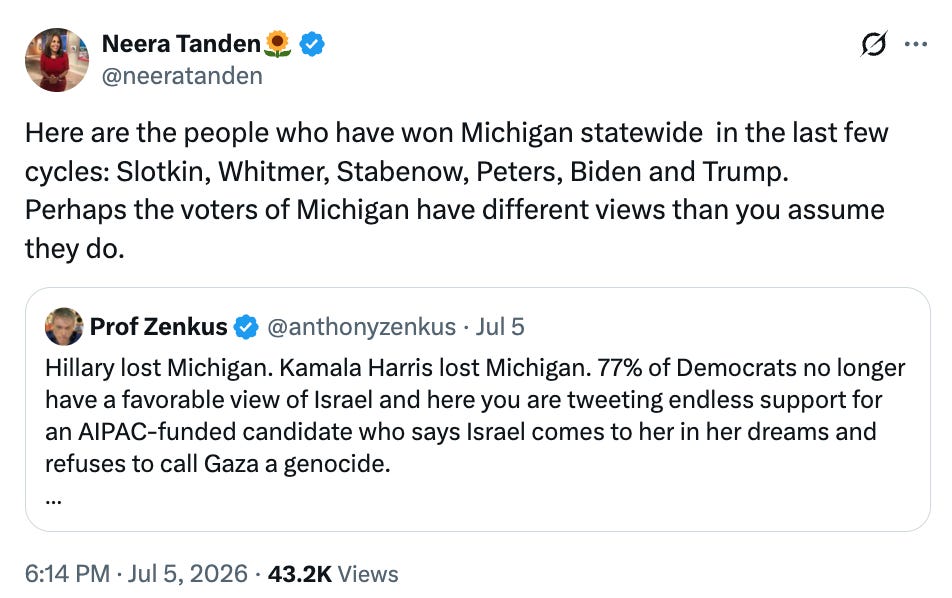
Tanden makes a fair point about Slotkin, who beat Mike Rogers narrowly two years ago. But that was in 2024 with Trump on the ballot. In 2026, in an anti-establishment pro-Democratic environment, progressives argue that the 2024 electability equation should be completely thrown out.
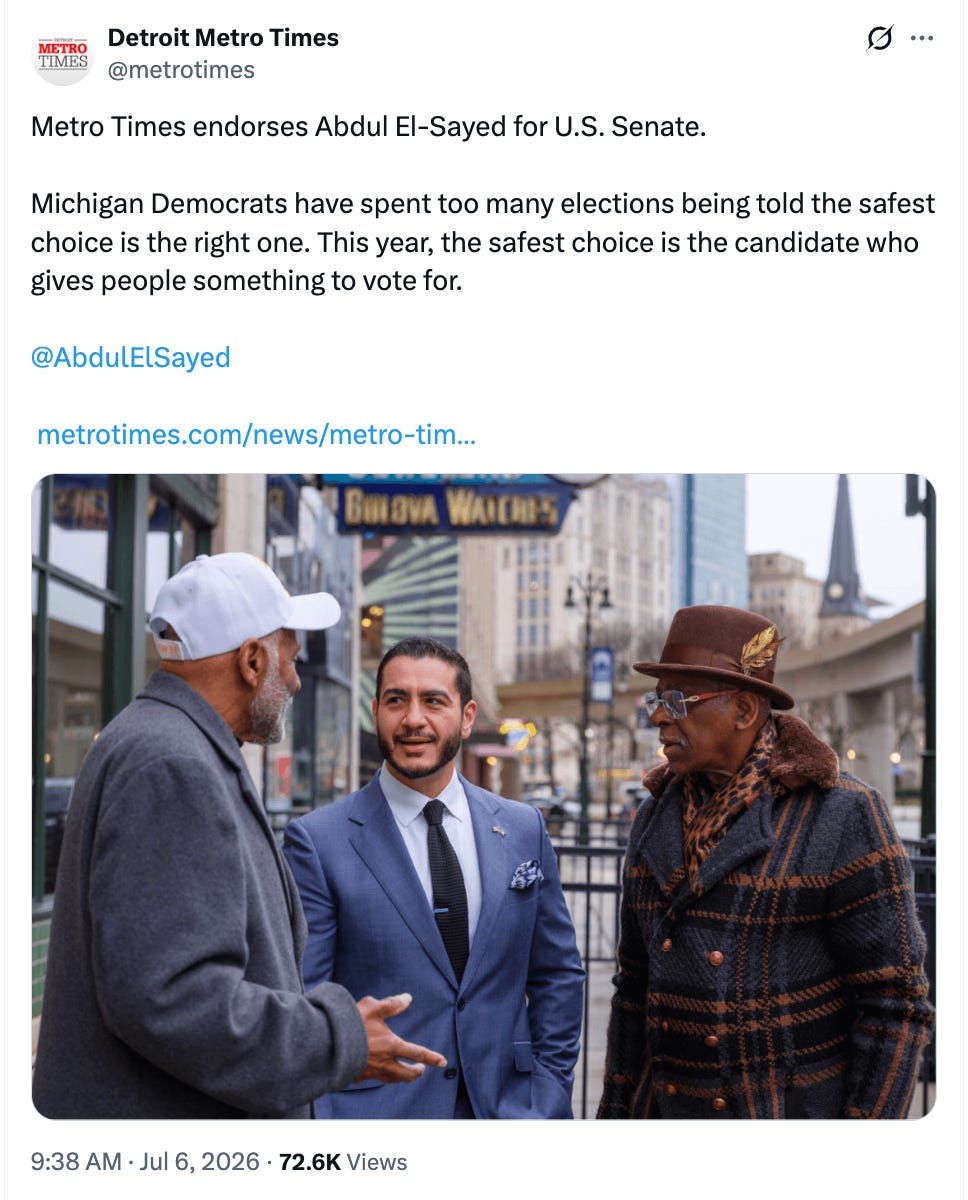
As The Detroit Metro Times pointed out in their endorsement of El-Sayed:
As AOC said in her endorsement of El-Sayed:
“After watching this campaign unfold for well over a year, it has become clear that Abdul El-Sayed is the strongest candidate to keep this seat in November,” Ocasio-Cortez, D-N.Y., said in a statement released by El-Sayed’s campaign. “He is building a winning coalition by putting forward an agenda that speaks directly to working people.”
And what is that agenda? Zohran Mamdani surged in the mayoral race last year with a list of three catchy, memorable policy proposals. repeated ad nauseum. El-Sayed has emulated this winning strategy, even making his list alliterative:
“Get money out of politics, put money in pockets, and pass Medicare for All.”
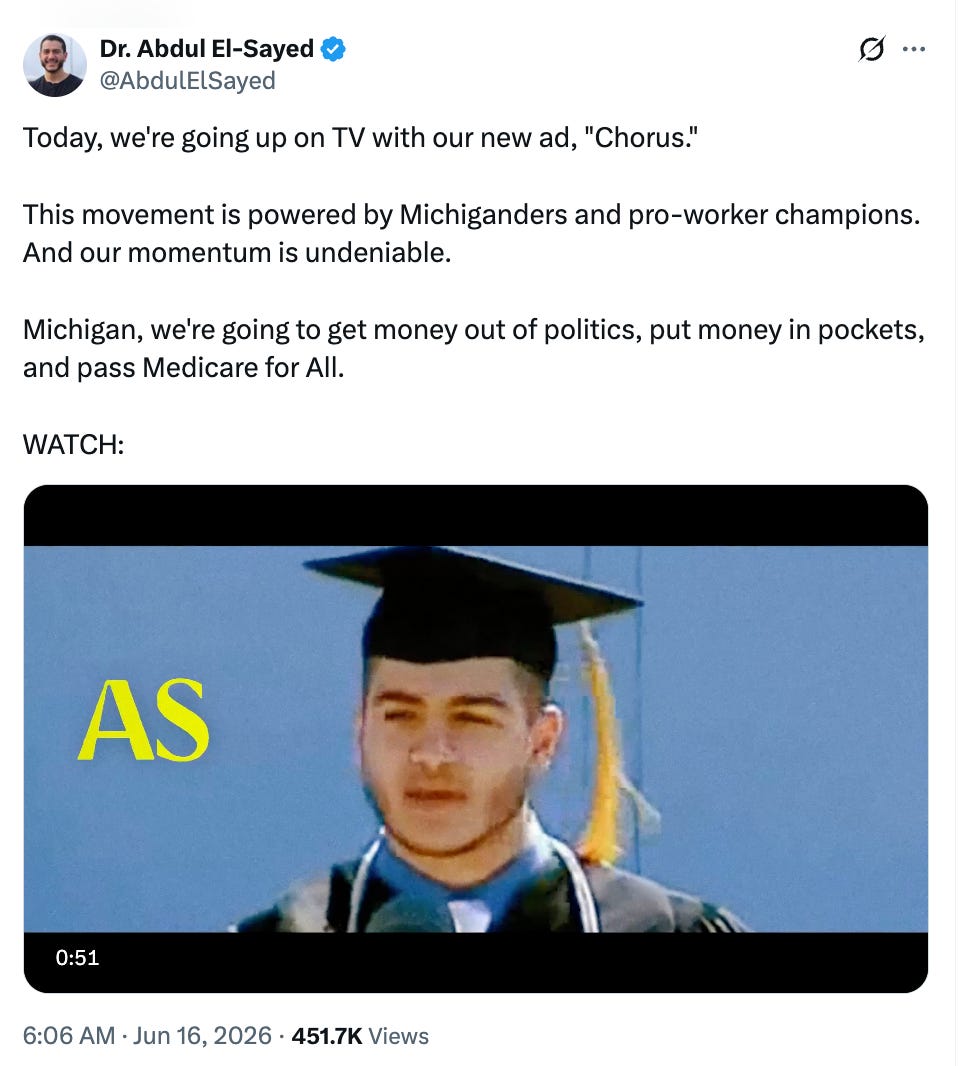
Rep. Maxwell Frost understood the assignment:

As did Rep. Delia Ramirez:

Think back to how Trump won swing states like Michigan in 2024. Was it because Michigan is more conservative? That’s what the Democratic establishment would argue. But progressives like El-Sayed are betting that it was something else entirely. As Mamdani proved last year when he brought 2024 Trump voters back into the Democratic fold, Trump too was able to succeed because he had a clearly communicated message laying out for every voter what he stood for: “Lowering costs on day one, closing the border, and ending foreign wars.” It was a lie, but it was clear and memorable. No one can recite what Kamala Harris’s message was.
El-Sayed’s campaign represents an opportunity for progressives to prove that what worked for Mamdani in New York, and frankly, what worked for Trump in swing states two years ago, can work for a left-wing anti-establishment candidate in swingy Michigan. And, in the process, prove the concept of a whole new model of electability.
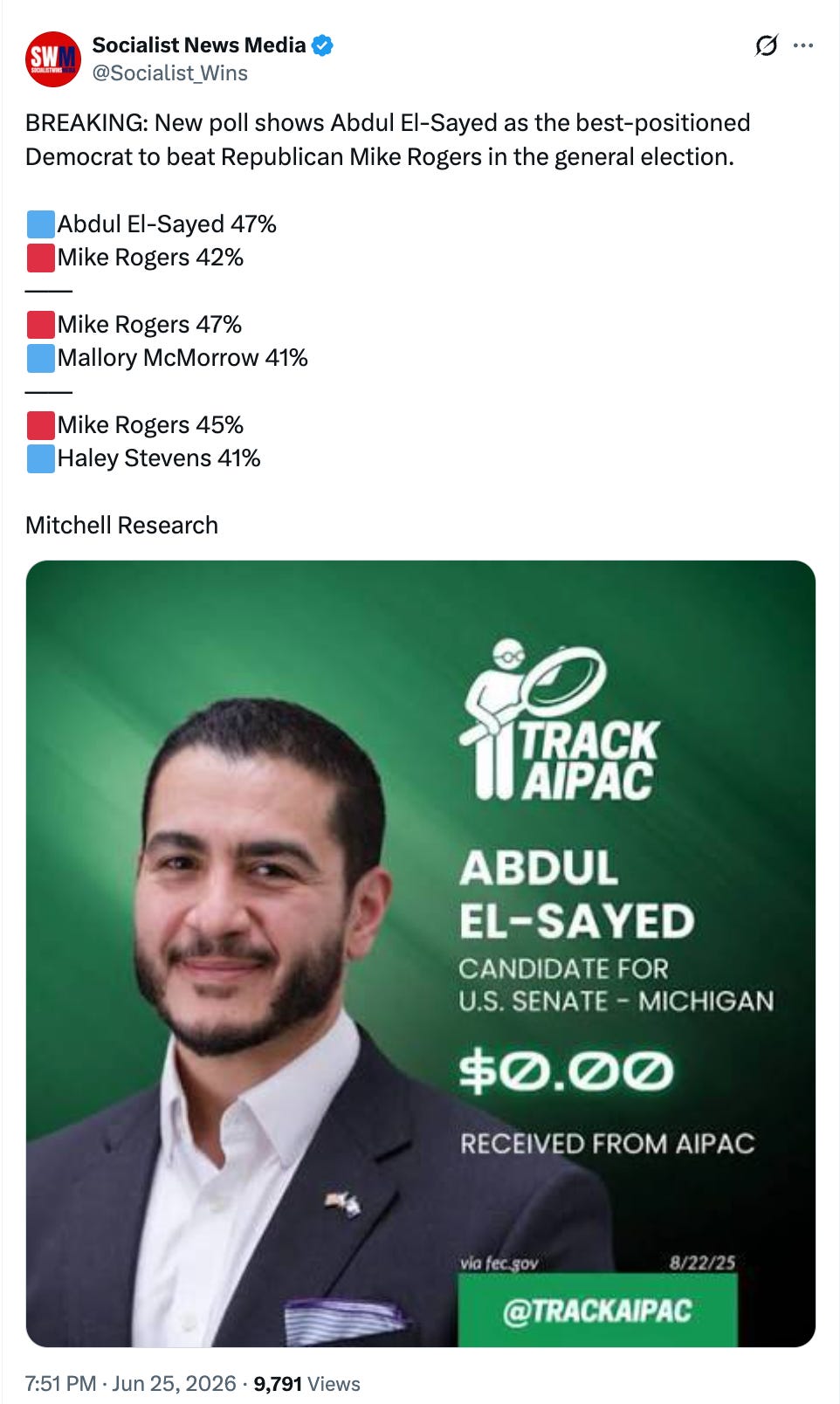
Based on two recent polls of the Michigan Senate general electorate, it appears voters agree with him.
Not only does Stevens’s relative moderation and establishment backing not give her an advantage against Republican Mike Rogers…
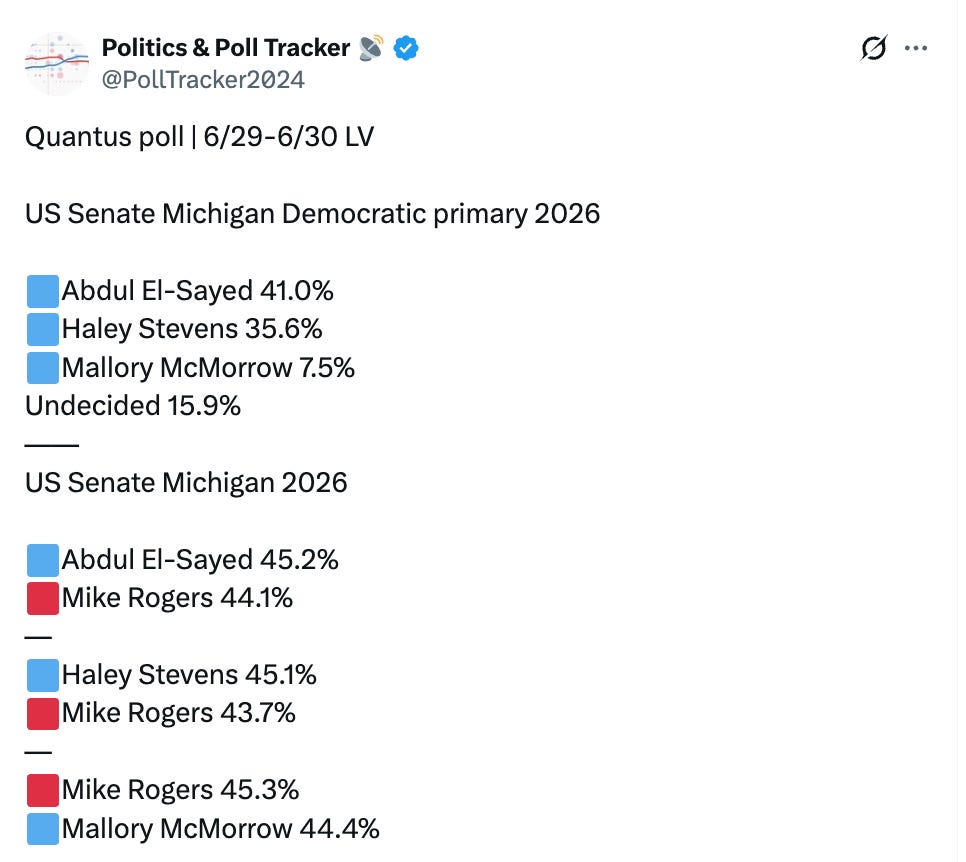
In fact, in one poll taken by Republican strategist Steve Mitchell that historically leans right, El-Sayed is the only candidate actually positioned to beat Rogers.
Even with all the lessons Democrats should have learned following Zohran Mamdani’s dispatching of Andrew Cuomo in last year’s election, when asked what she was doing to prepare for tonight’s debate, Haley Stevens seemed at best unprepared for the question.
“I’m looking forward to getting up there to continue to make my case for Michiganders. You know, I uh, you know, I think I got a winning message, and, I gotta show the fight and I’m going to be doing that tomorrow in Grand Rapids.”
Anti-Israel vs. AIPAC
One aspect of Stevens’ message that is sure to come up is her unwavering support for Israel and the backing she enjoys from AIPAC, Israel’s political lobby in the U.S.
The issue of Israel and Palestine blew up among young progressives in the wake of the bloody terrorist attacks by Hamas on October 7, 2023 against Israel. In the ensuing years, as the Biden and then the Trump administrations continued to fund and arm what has been officially labeled genocidal military response in Gaza, the politics of the issue have completely flipped.
El-Sayed versus Stevens provides a perfect test run of this conflict.
A recent poll by The AP/NORC found just how much support for Israel has eroded, particularly among Democratic voters:
Among the most significant findings, 58% of Democrats now say the US is “too supportive” of Israel, up from 45% in January 2024. That shift includes 51% of Jewish Democrats. Meanwhile, 62% of Democrats say the US is “not supportive enough” of Palestinians, up from 49% in 2024. Older Democrats are catching up to younger ones on this question: 57% of Democrats over 45 now say the US should do more for Palestinians, up sharply from 39% two years ago.
And you don’t have to take some leftist’s word for it. Ask Joe Scarborough, who recently made clear that the shift in public sentiment against Israel is the fault of Netanyahu and Netanyahu alone, stating,
“The idea that you’re going to be able to brutalize children and women in Gaza with bombing that looks indiscriminate on TV day in and day out for years, that you’re going to be able to level half of Lebanon, that you’re going to be able to continue to allow thugs to run wild in the West Bank, and brutalizing Palestinians, brutalizing Christians in Bethlehem, brutalizing Christians across that area along with Palestinian Muslims, especially Palestinian Muslims, blowing up Catholic churches in Gaza... You can blame all of this on Benjamin Netanyahu.”
And nothing underscores the shift in public sentiment on this issue more than Rahm Emanuel’s planned speech in Tel Aviv on Wednesday, reportedly to send a tough love message to Netanyahu that “Israelis should consider U.S. support expressly contingent.”
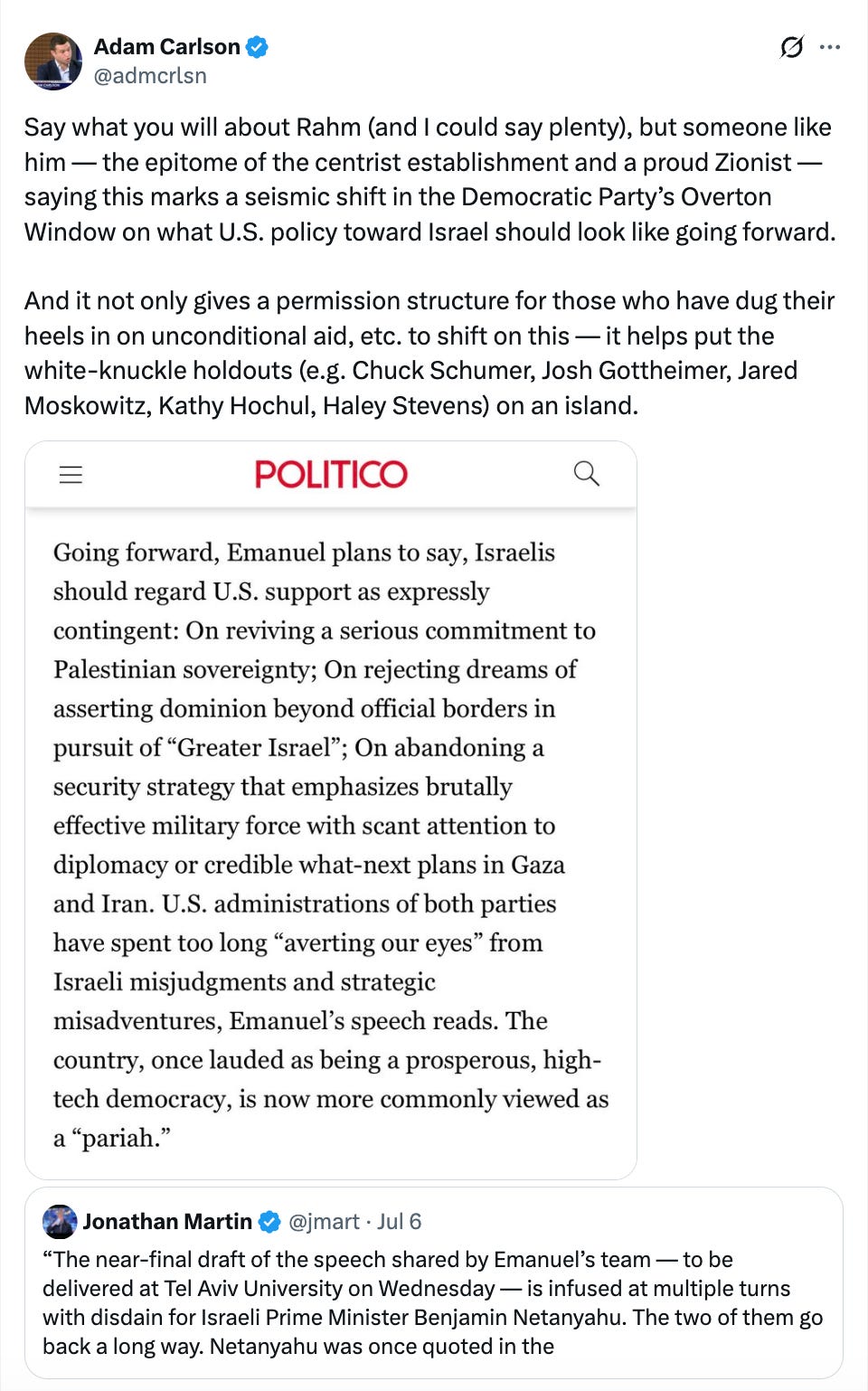
This is notable coming from Emanuel for a few reasons. Not only is he Jewish and clearly considering a 2028 presidential run, but having served multiple presidents and as an elected House Representative and Mayor of Chicago, few embody the pro-Israel establishment more than he does.
It is against this backdrop that Stevens is running a campaign embracing AIPAC’s support, having recorded a video touting their support as recently as March.
As pollster Adam Carlson put it bluntly on X:

The anger at her extreme pro-Israel stance bubbled up in April at the Michigan Democratic Party convention, where Stevens was loudly booed for accepting money from AIPAC.
And this video from 2023 is doing her no favors.
Of all the top contenders for the Michigan Senate nomination, Stevens was the only one not to disavow AIPAC money. It will be interesting to see if she uses Emanuel’s Tel Aviv speech as cover to attempt to distance herself from AIPAC at the debate tonight. Or if she intends to pull the right-wing maneuver against El-Sayed of conflating opposition to Israel with antisemitism.
Either way it could be too little too late for Stevens. As I wrote last week, Chris Hayes recently broke down what he sees as the salience of the issue for Democratic voters, calling it “a threshold issue” for them, an echo of 20 years ago.
“It’s not that it’s the most important issue, it’s that it says something about you. If you supported the Iraq war [in the aughts], it meant that you were a coward, wrong, not a fighter, too easily cowed, wouldn’t stand up for values, wouldn’t lead, wouldn’t be bold. All those things bleed together.”
“Support for the Israeli military’s actions in Gaza after October 7 has become a similar issue for many primary voters.”
The Moderates Make Their Case
While DSA’s June 23rd New York City primary victories may have woken up moderates decrying the leftward tilt of the party, the prospect of possibly losing the U.S. Senate just when it feels in reach has really set them off. Whether it’s Platner in Maine or El-Sayed in Michigan, moderates are striking back.
Many are doing so in good faith, out of actual concern for the electoral future of Democrats, particularly as we head into November.
Jonathan Chait of The Atlantic, who, while liberal, has often taken to scolding the far left, used his recent column to argue that Democratic voters should beware the rise of the DSA within their party’s ranks, asserting that “There’s Nothing Democratic About These Socialists.” His concern is largely a slippery slope/worst case scenario argument. Chait posits that the DSA despises the Democratic Party almost as much as they despise the Republican Party and Democratic voters should beware of their motivations. Is it really in their interests for Democrats to grow majorities, when that would serve to actually dilute the influence of their small number?
What Chait ignores is that this crew of DSA-backed candidates and elected leaders understand the only way to wield the power they ran for in order to effect change, is for Democrats in fact to win back majorities. I would bet against his cynical reading of the movement’s motives.
Strategist Rachel Bitecofer sees the rise of the DSA left, particularly the potential nomination of El-Sayed in Michigan’s upcoming Democratic Senate primary, as a dire threat to retaking the Senate. While most of DSA’s wins have been in safe blue seats, that is not the case in the Michigan Senate race. So her argument against El-Sayed is one of electability alone.
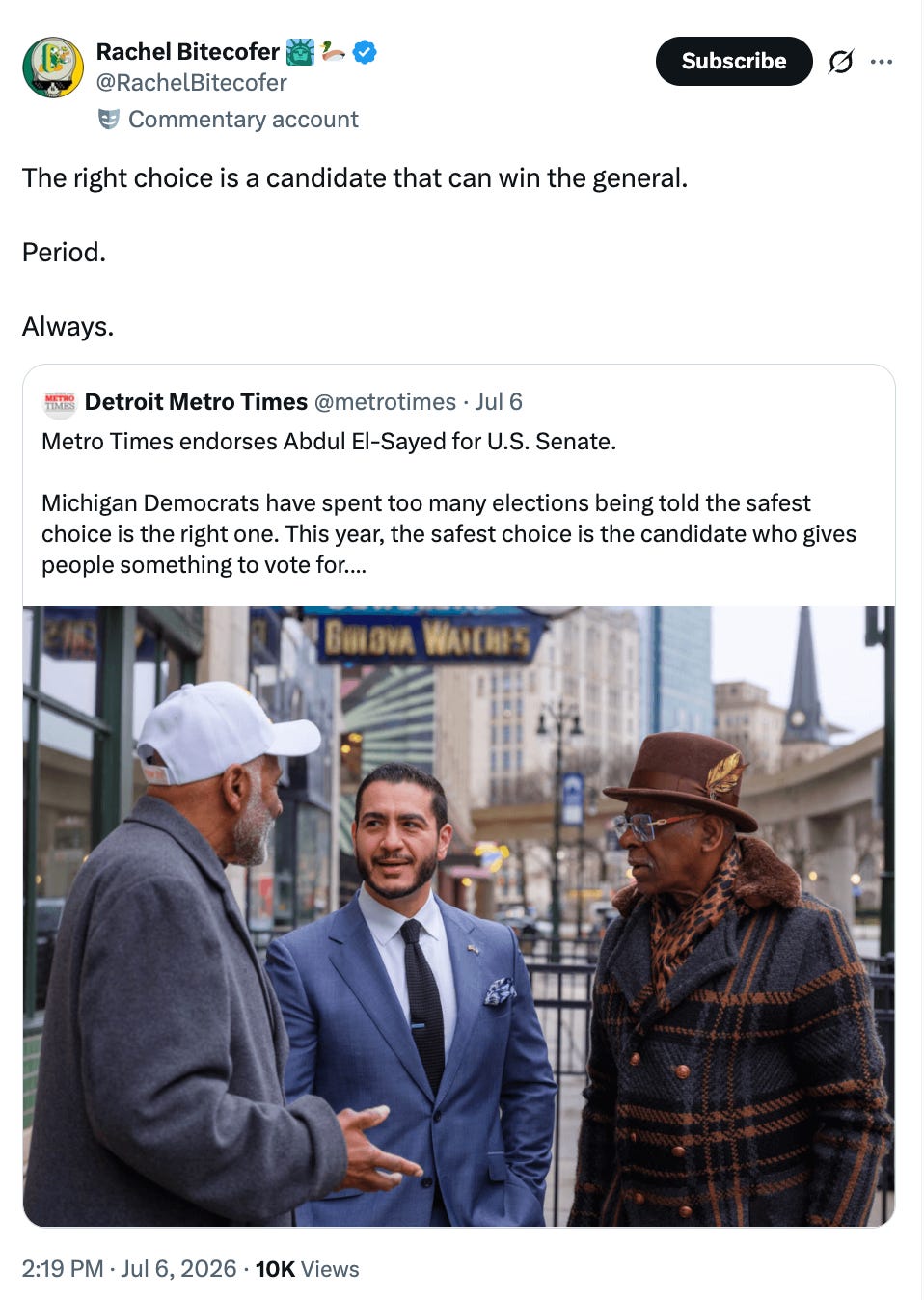
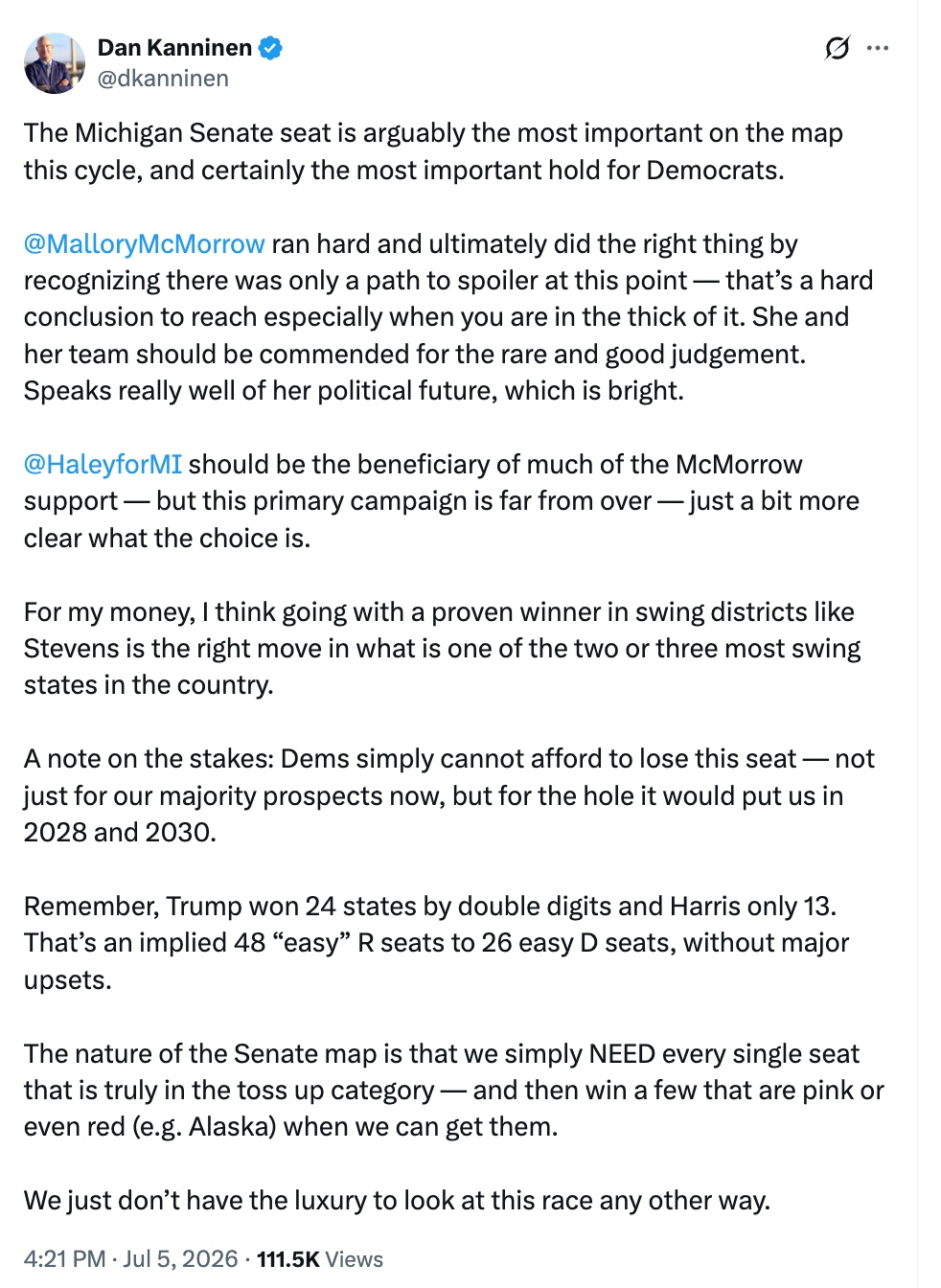
Shannon Watts, the anti-gun violence activist, founder of Moms Demand Action for Gunsense, agrees with Bitecofer. She amplified this post by Biden/Harris alum Dan Kanninen, who made the establishment’s old stand-by electability case,
@HaleyforMI should be the beneficiary of much of the McMorrow support — but this primary campaign is far from over — just a bit more clear what the choice is.
For my money, I think going with a proven winner in swing districts like Stevens is the right move in what is one of the two or three most swing states in the country.
A note on the stakes: Dems simply cannot afford to lose this seat — not just for our majority prospects now, but for the hole it would put us in 2028 and 2030.
These thought leaders of the center left truly want Democrats to win the Senate. And there is genuine disagreement on strategy and what sort of environment we are in this. year.
Yet in the wake of the collapse of Graham Platner’s campaign in the last 24 hours, the moderates have been “told ya so”-ing, claiming that their warnings against El-Sayed in the Michigan Senate primary as a “too liberal” and “untested” candidate should be heeded; that he is a risk we can’t afford to take.
We will know much more in the coming days as polling begins to reflect the shifting tides, from McMorrow dropping out in Michigan, to Platner collapsing in Maine, to tonight’s head-to-head debate between El-Sayed and Stevens.
But if Democrats get their way in Maine, Platner dropping out will actually allow Democrats to hold a statewide caucus to select Platner’s replacement by the July 27 deadline. In the running is Troy Jackson, whom Sanders backed for Maine Governor and has now put forward as a replacement for Platner. Jackson has filed to run for U.S. Senate in the event that Platner steps aside, saying, “This is something I never considered, but if Graham’s stepping away, I am very, very interested and think I’m the best person to replace him.”
Jackson would be able to take Platner’s anti-oligarchy working class champion message, which thrust him to a historic primary win last month, and wield it against Collins in November. After all, as Platner always said, this was never about him.
And isn’t that the big difference between establishment politicians like Schumer or Stevens, and those who are trying to build something bigger like Bernie Sanders, AOC and El-Sayed? It’s never been about the candidate. It’s about the people they are fighting for and the movement they are building.
The progressive left understood this years ago. When will the establishment figure it out?
Trump retook the presidency in January 2025, the left has largely been unified in opposition to a common foe. No matter where on the political left one fell, Trump and his MAGA movement, which were widely viewed as ascendant both politically and culturally after the 2024 election, posed clear existential threats to progress. This united front largely remained intact throughout 2025 as Democratic candidates overperformed in special elections around the country and as the fight to counter Trump’s mid-decade redistricting scheme became yet another point of unity.
But what appeared to be a united front obscured some real divisions that have been exposed in recent weeks. An intra-party battle is brewing between the far-left insurgent wing and the moderate establishment faction of the Democratic Party.
While there have been signs of a rising left throughout this year’s primaries, New York City’s June 23rd Democratic primary results proved to be a turning point. Two candidates backed by Mayor Zohran Mamdani and the Democratic Socialists of America (DSA) ousted sitting Democratic members of the House. This feat was repeated a week later when DSA-backed Melat Kiros defeated 15-term progressive Rep. Diana DeGette in Colorado’s 1st District by 13-points.
The fight to control the U.S. Senate is the latest battle, as the race for the Democratic nomination for an open Senate seat in Michigan has narrowed to a DSA-backed progressive endorsed by Bernie Sanders and AOC, and a moderate sitting member of the House backed by Chuck Schumer and AIPAC.
Indeed, a more perfect proxy battle between the two Democratic factions could hardly be scripted than in the race between Dr. Abdul El-Sayed and Rep. Haley Stevens in Michigan’s August 4th Senate primary.
And while the establishment may have been late to react to the brewing insurgency of the DSA-backed left, with control of the U.S. Senate on the line the moderates are striking back. But is it too little too late? And does it risk long-term damage that could threaten Democrats’ chances to retake control of Congress in November?
The Battle For Michigan’s Senate Seat
On Sunday, Michigan State Senator Mallory McMorrow, who was widely seen as a comfortable “middle ground” pick in the Michigan Senate primary, dropped her bid for the seat, after polling in a distant third place.
That left DSA-backed El-Sayed head-to-head against Rep. Stevens, battling it out in the final weeks of the campaign. Their first debate is slated for this evening, and absentee ballots are already in voters’ hands and being accepted by state election officials.
This race pits the two factions of the Democratic Party against each other in three important ways.
Anti-Establishment Insurgency
The story of the 2026 Democratic primaries thus far has been clear: Democrats have let the establishment know that the status quo is not acceptable. After Democratic Party leaders failed to halt the rise of Donald Trump, not once but twice, and then largely failed to effectively respond to the radical authoritarianism of his second term, Democratic voters want candidates who will shake up the system, not perpetuate it.
The first signs of this came last summer with Zohran Mamdani’s stunning primary win over Andrew Cuomo in the NYC mayoral race, and then with the emergence of Graham Platner in the Maine Senate race. Bernie Sanders’ endorsements of both of these young, anti-establishment insurgent candidates helped fuel their rise as champions for the working class against the oligarchic ruling elites and the political status quo.
By November, Mamdani dominated in the general election and Platner continued to catch fire in Maine, even amid multiple scandals. Ultimately, Senator Chuck Schumer recruited the popular sitting Governor of Maine, Janet Mills, to join the race as a check against an untested anti-establishment candidate. But in the anti-status quo change environment of 2026, Mills proved to be the exact wrong pick to blunt the rise of an insurgent challenger. Mills’s campaign fizzled, and she suspended her campaign. Platner won the primary decisively on June 9 with 72% of the vote.
With the recent credible accusation of sexual assault against Platner, his candidacy serves as a cautionary tale that more establishment-friendly moderates are already spinning as vindication. But this ignores the very real energy Platner inspired among base voters, which led him to receive the most votes ever in a Democratic primary in Maine’s history. It was this platform of passing Medicare for All, ending foreign wars, and championing workers over the wealthy and corporations that has fueled other insurgent campaigns all this year, particularly in deep blue House districts.
In the February 5th special election primary to fill Governor Mikie Sherrill’s House seat in NJ-11, AOC-backed activist Analilia Mejia narrowly defeated former Congressman Tom Malinowski for the seat. On May 19, AOC’s endorsement helped put Democratic Socialist state Rep. Chris Rabb over the top in Pennsylvania’s Third District. Then came the June 23rd earthquake in New York City, when all three of Zohran Mamdani’s DSA-backed candidates won against establishment-endorsed candidates, followed a week later by Melat Kiros’s stunning upset against Diana DeGette in Colorado’s 1st District.
Against this backdrop, the scene is set for the head-to-head match-up of the Sanders- and AOC-backed El-Sayed versus the Schumer-backed Stevens for the Democratic primary for U.S. Senate in Michigan. And from the arguments those who’ve endorsed Stevens are making, their central argument is clear:
Senator Chuck Schumer told Punch Bowl News:
“I think she has the best chance to win.”
Stevens herself said on X recently,
“If you want to flip the Senate, I’m your gal.”
A line she repeated here.
EMILY’s List said in their endorsement,
Haley is a proven fighter for Michigan workers and families — and the strongest candidate to hold this critical seat, defeat Mike Rogers, and deliver real results in the Senate.
The difference in the tone of those who have endorsed Dr. Abdul El-Sayed for the seat says everything about the difference in the calculus each faction is making for what “electability” means.
Old-Style Democratic Assumptions vs. Post-Trump Politics
Those in Stevens’ camp make a cold, historically-based calculation about what it means to be electable in a state like Michigan. But the insurgent progressive wing of the party’s response has been, “Well, how’s that been working out for us?”
“Better than you believe,” the moderates respond. This quote tweet from Biden administration veteran Neera Tanden sums up their argument:
Tanden makes a fair point about Slotkin, who beat Mike Rogers narrowly two years ago. But that was in 2024 with Trump on the ballot. In 2026, in an anti-establishment pro-Democratic environment, progressives argue that the 2024 electability equation should be completely thrown out.
As The Detroit Metro Times pointed out in their endorsement of El-Sayed:
As AOC said in her endorsement of El-Sayed:
“After watching this campaign unfold for well over a year, it has become clear that Abdul El-Sayed is the strongest candidate to keep this seat in November,” Ocasio-Cortez, D-N.Y., said in a statement released by El-Sayed’s campaign. “He is building a winning coalition by putting forward an agenda that speaks directly to working people.”
And what is that agenda? Zohran Mamdani surged in the mayoral race last year with a list of three catchy, memorable policy proposals. repeated ad nauseum. El-Sayed has emulated this winning strategy, even making his list alliterative:
“Get money out of politics, put money in pockets, and pass Medicare for All.”
Rep. Maxwell Frost understood the assignment:
As did Rep. Delia Ramirez:
Think back to how Trump won swing states like Michigan in 2024. Was it because Michigan is more conservative? That’s what the Democratic establishment would argue. But progressives like El-Sayed are betting that it was something else entirely. As Mamdani proved last year when he brought 2024 Trump voters back into the Democratic fold, Trump too was able to succeed because he had a clearly communicated message laying out for every voter what he stood for: “Lowering costs on day one, closing the border, and ending foreign wars.” It was a lie, but it was clear and memorable. No one can recite what Kamala Harris’s message was.
El-Sayed’s campaign represents an opportunity for progressives to prove that what worked for Mamdani in New York, and frankly, what worked for Trump in swing states two years ago, can work for a left-wing anti-establishment candidate in swingy Michigan. And, in the process, prove the concept of a whole new model of electability.
Based on two recent polls of the Michigan Senate general electorate, it appears voters agree with him.
Not only does Stevens’s relative moderation and establishment backing not give her an advantage against Republican Mike Rogers…
In fact, in one poll taken by Republican strategist Steve Mitchell that historically leans right, El-Sayed is the only candidate actually positioned to beat Rogers.
Even with all the lessons Democrats should have learned following Zohran Mamdani’s dispatching of Andrew Cuomo in last year’s election, when asked what she was doing to prepare for tonight’s debate, Haley Stevens seemed at best unprepared for the question.
“I’m looking forward to getting up there to continue to make my case for Michiganders. You know, I uh, you know, I think I got a winning message, and, I gotta show the fight and I’m going to be doing that tomorrow in Grand Rapids.”
Anti-Israel vs. AIPAC
One aspect of Stevens’ message that is sure to come up is her unwavering support for Israel and the backing she enjoys from AIPAC, Israel’s political lobby in the U.S.
The issue of Israel and Palestine blew up among young progressives in the wake of the bloody terrorist attacks by Hamas on October 7, 2023 against Israel. In the ensuing years, as the Biden and then the Trump administrations continued to fund and arm what has been officially labeled genocidal military response in Gaza, the politics of the issue have completely flipped.
El-Sayed versus Stevens provides a perfect test run of this conflict.
A recent poll by The AP/NORC found just how much support for Israel has eroded, particularly among Democratic voters:
Among the most significant findings, 58% of Democrats now say the US is “too supportive” of Israel, up from 45% in January 2024. That shift includes 51% of Jewish Democrats. Meanwhile, 62% of Democrats say the US is “not supportive enough” of Palestinians, up from 49% in 2024. Older Democrats are catching up to younger ones on this question: 57% of Democrats over 45 now say the US should do more for Palestinians, up sharply from 39% two years ago.
And you don’t have to take some leftist’s word for it. Ask Joe Scarborough, who recently made clear that the shift in public sentiment against Israel is the fault of Netanyahu and Netanyahu alone, stating,
“The idea that you’re going to be able to brutalize children and women in Gaza with bombing that looks indiscriminate on TV day in and day out for years, that you’re going to be able to level half of Lebanon, that you’re going to be able to continue to allow thugs to run wild in the West Bank, and brutalizing Palestinians, brutalizing Christians in Bethlehem, brutalizing Christians across that area along with Palestinian Muslims, especially Palestinian Muslims, blowing up Catholic churches in Gaza... You can blame all of this on Benjamin Netanyahu.”
And nothing underscores the shift in public sentiment on this issue more than Rahm Emanuel’s planned speech in Tel Aviv on Wednesday, reportedly to send a tough love message to Netanyahu that “Israelis should consider U.S. support expressly contingent.”
This is notable coming from Emanuel for a few reasons. Not only is he Jewish and clearly considering a 2028 presidential run, but having served multiple presidents and as an elected House Representative and Mayor of Chicago, few embody the pro-Israel establishment more than he does.
It is against this backdrop that Stevens is running a campaign embracing AIPAC’s support, having recorded a video touting their support as recently as March.
As pollster Adam Carlson put it bluntly on X:
The anger at her extreme pro-Israel stance bubbled up in April at the Michigan Democratic Party convention, where Stevens was loudly booed for accepting money from AIPAC.
And this video from 2023 is doing her no favors.
Of all the top contenders for the Michigan Senate nomination, Stevens was the only one not to disavow AIPAC money. It will be interesting to see if she uses Emanuel’s Tel Aviv speech as cover to attempt to distance herself from AIPAC at the debate tonight. Or if she intends to pull the right-wing maneuver against El-Sayed of conflating opposition to Israel with antisemitism.
Either way it could be too little too late for Stevens. As I wrote last week, Chris Hayes recently broke down what he sees as the salience of the issue for Democratic voters, calling it “a threshold issue” for them, an echo of 20 years ago.
“It’s not that it’s the most important issue, it’s that it says something about you. If you supported the Iraq war [in the aughts], it meant that you were a coward, wrong, not a fighter, too easily cowed, wouldn’t stand up for values, wouldn’t lead, wouldn’t be bold. All those things bleed together.”
“Support for the Israeli military’s actions in Gaza after October 7 has become a similar issue for many primary voters.”
The Moderates Make Their Case
While DSA’s June 23rd New York City primary victories may have woken up moderates decrying the leftward tilt of the party, the prospect of possibly losing the U.S. Senate just when it feels in reach has really set them off. Whether it’s Platner in Maine or El-Sayed in Michigan, moderates are striking back.
Many are doing so in good faith, out of actual concern for the electoral future of Democrats, particularly as we head into November.
Jonathan Chait of The Atlantic, who, while liberal, has often taken to scolding the far left, used his recent column to argue that Democratic voters should beware the rise of the DSA within their party’s ranks, asserting that “There’s Nothing Democratic About These Socialists.” His concern is largely a slippery slope/worst case scenario argument. Chait posits that the DSA despises the Democratic Party almost as much as they despise the Republican Party and Democratic voters should beware of their motivations. Is it really in their interests for Democrats to grow majorities, when that would serve to actually dilute the influence of their small number?
What Chait ignores is that this crew of DSA-backed candidates and elected leaders understand the only way to wield the power they ran for in order to effect change, is for Democrats in fact to win back majorities. I would bet against his cynical reading of the movement’s motives.
Strategist Rachel Bitecofer sees the rise of the DSA left, particularly the potential nomination of El-Sayed in Michigan’s upcoming Democratic Senate primary, as a dire threat to retaking the Senate. While most of DSA’s wins have been in safe blue seats, that is not the case in the Michigan Senate race. So her argument against El-Sayed is one of electability alone.
Shannon Watts, the anti-gun violence activist, founder of Moms Demand Action for Gunsense, agrees with Bitecofer. She amplified this post by Biden/Harris alum Dan Kanninen, who made the establishment’s old stand-by electability case,
@HaleyforMI should be the beneficiary of much of the McMorrow support — but this primary campaign is far from over — just a bit more clear what the choice is.
For my money, I think going with a proven winner in swing districts like Stevens is the right move in what is one of the two or three most swing states in the country.
A note on the stakes: Dems simply cannot afford to lose this seat — not just for our majority prospects now, but for the hole it would put us in 2028 and 2030.
These thought leaders of the center left truly want Democrats to win the Senate. And there is genuine disagreement on strategy and what sort of environment we are in this. year.
Yet in the wake of the collapse of Graham Platner’s campaign in the last 24 hours, the moderates have been “told ya so”-ing, claiming that their warnings against El-Sayed in the Michigan Senate primary as a “too liberal” and “untested” candidate should be heeded; that he is a risk we can’t afford to take.
We will know much more in the coming days as polling begins to reflect the shifting tides, from McMorrow dropping out in Michigan, to Platner collapsing in Maine, to tonight’s head-to-head debate between El-Sayed and Stevens.
But if Democrats get their way in Maine, Platner dropping out will actually allow Democrats to hold a statewide caucus to select Platner’s replacement by the July 27 deadline. In the running is Troy Jackson, whom Sanders backed for Maine Governor and has now put forward as a replacement for Platner. Jackson has filed to run for U.S. Senate in the event that Platner steps aside, saying, “This is something I never considered, but if Graham’s stepping away, I am very, very interested and think I’m the best person to replace him.”
Jackson would be able to take Platner’s anti-oligarchy working class champion message, which thrust him to a historic primary win last month, and wield it against Collins in November. After all, as Platner always said, this was never about him.
And isn’t that the big difference between establishment politicians like Schumer or Stevens, and those who are trying to build something bigger like Bernie Sanders, AOC and El-Sayed? It’s never been about the candidate. It’s about the people they are fighting for and the movement they are building.
The progressive left understood this years ago. When will the establishment figure it out?
2 things: one, I don’t like the terms “far-left” and “insurgent.” The progressives running would be moderate in many other countries.
And (2) why does it have to be some grand melodramatic battle? Democratic socialists work well in some cities or regions and not others. Mamdani works in NY, Talarico works in Texas (fingers crossed). Why does there have to be some kind of top-down control? Why not let the voters decide via primaries — as they have been? A leader for the national stage should be able to emerge organically.
Regardless of what Platner decides, I see a ray of sunshine within this particular storm cloud.
Take a look at the most popular political figures in the country right now.
Top 6 most popular are liberal Democrats, or Democratic socialists. No centrist Democrats, no Republicans of any kind.
Platner may not appear on this list, but his platform does….at the top. Mainers knew from the beginning that his character was in question, but his platform is why he won his primary, personal issues notwithstanding.
I find that hopeful. The DemSoc movement is exploding, and the GOP knows it.
They are Trump's ‘Communists’. Why else would he and the GOP suddenly start banging this particular drum so loudly and so often?
AOC is 6th most popular, nearly tied with the top Republican, Rubio, and Kamala Harris.
You'll also notice how few straight white men there are in the top third of this list. And Rubio, a POC and son of immigrants, has the third highest 'don't know' percentages of the 7 Republicans mentioned by name….but still ranks higher than the rest.
Vance and Trump are tied, BEHIND the Republican party….and way behind Jon Ossof at #5, even though 55% of respondents admitted they knew nothing about him!!
AND they're both also ranked behind Gavin Newsom. Musk ranks even lower.
Tucker Carlson, who's been tagged as the Great White Hope of Republicans in 2028 barely made the list, and look at the percentages of people that don't know anything about him compared to the same number for AOC....and then see the wide disparity in their rankings.
Yikes, that does not speak well of Carlson and where he ranks with the people that DO know him. Conversely, it speaks well of the Democratic socialist platform that AOC, with nearly the same recognition percentage, ranks so close to the top
Added to this, the non-partisan platform http://vote.org/ reports record-breaking voter registration in the first half of 2026.
38% of those who used the platform to register, so far this year were 18-years-old, and nearly 80% were under the age of 35.
Who do you think these new young voters are going to support?
No wonder Republicans are trotting out that old dead horse of McCarthyism.
They have nothing else to offer.
And look where Dem party leaders appear on the list. They also have nothing to offer, but folks seem to recognize who does, and they're still Democrats.
As an interesting side note...my mom, a three time Trump voter....loved Bernie Sanders in 2016.