

The Election False Flag Has A Standard Bearer
To understand the true threat to the 2026 elections, look first at the man behind the plan


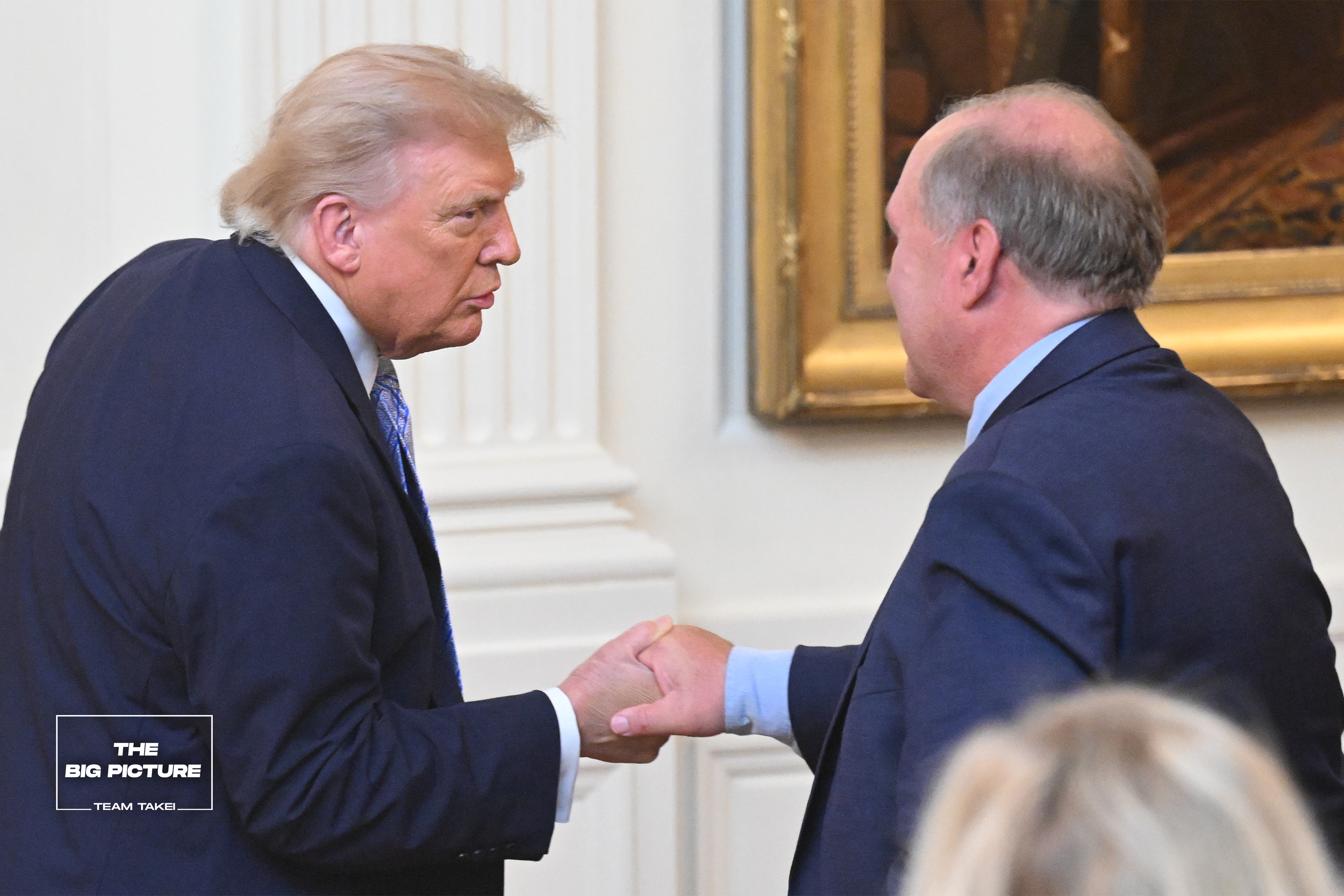
Before last week’s “election security” speech, Donald Trump had teased the announcement for days, promising revelations about foreign interference in our election. His 25-minute address wound up being, as Election Law Blog’s Rick Hasen called it, “an underwhelming announcement delivered with low energy.”
David Becker of the Center for Election Innovation & Research also pulled no punches. As Democracy Docket reported, Becker noted, “They’ve had 18 months in total control of the federal government and they have found nothing that would support President Trump’s lies about the 2020 election,” adding “so they are just trying to grab as much garbage and throw it up against the wall, and it’s not sticking.” Nevada Secretary of State Cisco Aguilar’s verdict, delivered to reporters at a secretaries of state conference in Rapid City, was blunter still: “That was some bullshit.”
Trump may have delivered a nothingburger speech, but it was nefarious in a different, less understood way. Hidden within the garbage he threw at the wall lies a trap, one that could undermine the 2026 midterms in two ways.
First, as Trump’s advisers have already begun to argue, American election systems are so compromised that they justify sweeping federal intervention. That could include new mandates on voting machines, forced access to state voter rolls and new executive orders — or even “national emergency” decrees — built on the “shocking vulnerabilities” outlined in Trump’s address.
Second, the vulnerabilities of our systems could become self-fulfilling. Trump’s speech fed a narrative of security failures in our election systems, but notably only after he spent a year and a half hollowing out that very election infrastructure. Our measures no longer fully deter or halt foreign interference; Trump’s actions are akin to throwing the vault doors wide open while decrying that robbers now have full access to everything.
But Trump isn’t clever or nimble enough on his own to make all the pieces come together for a full-blown election steal. For that, he turned to someone well-known to Washington insiders but whose face and name most of the public does not yet recognize.
He is John Solomon, and wherever he turns up, something dangerous is usually already in motion. His decade-long record of conspiratorial political shenanigans reveals how the White House’s election playbook will likely operate: by building stories with enough innuendo to survive scrutiny, just long enough for the regime to leverage the false claims into something far larger and more dangerous.
The Solomon method
Solomon’s reputation for manipulation preceded Trump’s rise to power. In 2007, the Columbia Journalism Review warned that Solomon was part of a class of reporters able to “churn out a steady stream of mediocrity, with little consequence.” It cited a run of front-page Washington Post stories, including one the paper’s own ombudsman said left readers looking in vain for the actual scandal.
The pattern repeated at scale a decade later. While working at The Hill in 2017, Solomon co-reported on an alleged Russian bribery scheme tied to the so-called Uranium One deal. His reporting fed into a broader claim, pushed by conservative media and later by Trump himself, that Hillary Clinton had approved the sale of American uranium rights in exchange for donations to the Clinton Foundation. But FactCheck.org found no evidence of that underlying quid pro quo.
In 2019, Solomon moved from insinuation to apparent coordination. According to ProPublica’s reporting, Solomon worked directly with Lev Parnas, then an associate of Rudy Giuliani, who was later convicted on campaign finance charges, to build the case that Joe Biden had pressured Ukraine into firing a prosecutor investigating a company tied to his son. Parnas helped arrange Solomon’s interview with then-Ukrainian prosecutor Yuriy Lutsenko and watched it live from the control room of The Hill’s TV studio. Solomon shared files with Parnas and sent his own lawyers, Joe diGenova and Victoria Toensing, an advance copy of one of the resulting stories.
None of it held up. Lutsenko backed off his own allegations within a month, and the State Department called the underlying claim an “outright fabrication.” Solomon’s defense at the time pointed to Parnas: “No one knew there was anything wrong with Lev Parnas at the time,” he argued. But the sequence mattered more than the accuracy, and the damage was done. Solomon’s columns ran, and Ambassador Marie Yovanovitch was recalled within a month of the series starting. The storyline then grew into the first Trump impeachment inquiry.
A weasel inside the White House
The Bulwark has since traced Solomon’s rise from conservative media into the White House.
After the Ukraine debacle, Solomon regrouped and spent the next several years building Just the News into a small media network. Its parent company acquired The Post Millennial and Human Events, with Solomon serving as board chairman and chief strategy and content officer, while helping run a funding operation linked to an undisclosed network of conservative outlets, including his own.
None of that would matter much if Solomon were still just a political commentator. But in June 2026, Trump made Solomon a “special government employee,” a status that allows him to serve without pay for up to 130 days. He was asked to help run a task force alongside newly installed acting Director of National Intelligence Bill Pulte. Their role was to decide which classified election documents to release to the public.
It wasn’t Solomon’s first time inside the classification process. Trump had already designated him one of his two personal representatives at the National Archives in 2022, a role that gave Solomon access he later used to publish the Crossfire Hurricane files in 2025.
Solomon’s current assignment reaches beyond declassification into the prosecutorial process itself. He told conservative commentator Benny Johnson in April that the documents his task force was releasing “will help this prosecutorial team in Miami,” referring to a grand jury effort staffed in part by his team of Ukraine-era lawyers, diGenova and Toensing. The goal was to help Trump pursue and prosecute his perceived enemies.
Even inside the White House, Solomon’s credibility problem persists. Conservative Treehouse, a pro-Trump blog, added a bolded caution to its own preview of Trump’s July 16 speech: “Caution should be noted as newly appointed Special Government Employee John Solomon is responsible for the content.”
They’ve already begun to spring the trap
The morning after Trump’s speech, his cronies swung into action. As Democracy Docket reported, Homeland Security Secretary Markwayne Mullin threatened election officials in all 50 states and Washington, D.C., with possible criminal prosecution if they refused to run their voter rolls through the SAVE database, a citizenship-verification tool a federal judge had already ruled unlawful weeks earlier. Mullin cited a figure of more than 250,000 noncitizens allegedly found on the rolls of four states, without explaining how DHS obtained the data or verified the number. Wendy Weiser of the Brennan Center called the figure “almost certainly false or wildly overstated,” and elections expert David Becker, who had attended a White House briefing on the methodology, said officials told him the number came from comparisons with commercial data too imprecise to support exact identifications.
Mullin also announced that DHS would withhold federal election security support from states that refused to comply with the administration’s new requirements, including use of SAVE. Separately, the administration has been trying to use the Commerce Department to impose new restrictions on voting machines. That gives the administration real leverage because states have long relied on that federal money to help secure their elections.
That is all within the first part of the trap: a manufactured sense of crisis used to justify federal control over voting machines that states already administer securely, voter rolls states already maintain and grant money states already depend on. Trump doesn’t have to prove any of it; he just has to insist that direct federal intervention is needed to preserve election integrity nationwide.
The second part is harder to spot because it depends on a foreign adversary deciding to test our weakness. Former federal prosecutor Andrew Weissmann, discussing Trump’s speech with The Bulwark’s Sarah Longwell, argued that the dismantling of our election apparatus amounts to an open invitation, a new kind of “Russia, are you listening?” moment. It signals to foreign adversaries that America’s defenses are down and sets up the regime to blame Democrats for vulnerabilities that Trump himself created. If there is an attack, even an unsuccessful one, Weissmann warns, the administration can declare the election compromised and use that claim as a pretext to seize ballots and election materials. If that seems far-fetched, it’s not much more than an update of the maneuver the FBI already carried out in Fulton County, Georgia, where in January agents seized roughly 656 boxes of 2020 election ballots, tabulator tapes and voter rolls.
The danger lurking in Trump’s speech
On July 19, Jonathan Karl of ABC News delivered a sobering, broader view of what Trump’s declassification of intelligence surrounding the 2020 election really seeks to achieve. He did so by walking through what the declassified documents actually say.
A January 2020 intelligence assessment, issued while Trump was president, found the U.S. election system would be very difficult to manipulate on a wide enough scale to alter an election outcome. Yet the only country the documents show actually attempting to target or manipulate American election systems was Russia, a country Trump mentioned only in passing.
The 220 million voter files reportedly obtained by China, which Trump described as an “unprecedented election security nightmare,” turned out to be data legally available for purchase online.Moreover, China didn’t obtain the files until 2022, two years after the election it supposedly helped steal.
Karl closed with a chilling observation. One of the intelligence assessments Trump declassified warned that a foreign adversary’s most damaging move isn’t hacking a voting machine. It’s convincing Americans that a machine was hacked when it never was. Karl noted that the person who has spent nearly six years doing exactly that is Trump himself.
Planning the predicate for a “national emergency”
Steve Bannon said the quiet part out loud during a podcast in June. He noted that Solomon’s task force, working alongside Bill Pulte as acting director of national intelligence, exists to build the “predicate” for a national emergency declaration on elections. As Media Matters reported in early July,
Bannon stated plainly on June 29 that Solomon’s “task force” and “also Pulte” would be central to creating a “predicate” for the declaration of a national emergency and subsequent executive order achieving the anti-voting rights goals of the SAVE America Act.
Then on June 30, Bannon interviewed one of his “Real America’s Voice” colleagues, Wayne Allyn Root, who elaborated on what a national emergency declaration could look like. “Stop talking about the SAVE Act and do a national security emergency for elections, which is the SAVE Act, which contains everything that’s in the SAVE Act, Steve, and more and more,” Root said.
A Bannon ally went further the next day, describing an emergency declaration that would functionally enact the stalled SAVE America Act without involving Congress at all — proof-of-citizenship requirements to register and vote, imposed nationally, by decree rather than statute.
ProPublica’s reporting revealed the mechanics were already in motion months before Thursday’s speech. In February, six federal officials, including a White House lawyer assigned to reinvestigate the 2020 election and the DHS official then in charge of election integrity, sat in on a private summit where activists pushed for exactly this outcome. A draft executive order already circulating among people connected to the group would ban mail-in ballots and eliminate voting machines nationwide, replacing them with hand-counted paper ballots. One funder at the summit described the eventual goal as the “muscular thing”: Trump declaring a national emergency and, in the words of one activist who left convinced Trump should do it, seizing “king-like powers” over voting systems, even though the Constitution expressly reserves the administration of federal elections to the states and Congress.
Trump has publicly denied considering any of it. But consider that this is the same man who denied any knowledge of Project 2025, many key aspects of which are now firmly in place.
Preparing for incoming attacks
Solomon, along with his supporters like Bannon and Pulte, doesn’t need China to have flipped a single vote. Indeed, when asked by MS NOW’s Vaughn Hillyard whether any votes had actually been changed in 2020, 2022 or 2024, Solomon admitted, “The intelligence community has zero evidence that a foreign power flipped the vote.”
Solomon only needs enough raw material — a stack of partially declassified documents, an unverifiable number from an unreliable database, a “vulnerability” that was never secret in the first place — to plant a false flag justifying a national emergency declaration by Trump.
That White House decree could target machines the states already securely operate. It could ban millions of mail-in ballots Americans regularly and safely use to vote. Or it could exploit an actual foreign adversary testing the security gaps the White House itself created. The outcome serves the same purpose: a midterm election that Americans can be talked into mistrusting, decided in the end not by the votes cast but by who gets to say which ones counted.
Trump knows that a national emergency declaration requires a paper trail, something his press secretary can wave at a podium or that radical Supreme Court justices can point to when the inevitable lawsuits arrive. Solomon has spent his career building exactly that kind of “report” through partial documents, selectively released, but presented with enough urgency that the underlying weakness gets lost in the breathless reporting and right-wing media amplification.
Solomon already did this with Uranium One. He pulled it off again with Ukrainian prosecutor Lutsenko. Both eventually fell apart under scrutiny, but not before they had inflicted real damage. Now his new and far more dangerous target is the November midterm elections.
The difference this time is that we know the playbook and the players. We can call out what they are doing and fortify our election systems, weakened as they are, for the inevitable onslaught. Importantly, we can educate the public, our election officials, our lawmakers and our judiciary about the threat. And we can prepare the nation for incoming false election claims before they are deployed against us.
Think of it as a “Patriot defense system” to keep our republic safe. To defend ourselves successfully, we must first understand the nature and trajectory of the rhetorical missiles and scattershot conspiracies heading our way. Armed with that knowledge, we can shoot down the threats to our elections one by one, or even en masse, as they cross into our cherished democratic airspace in the coming months.
I drop off my mailed ballot at the courthouse, as I no longer trust the USPS to deliver it in a timely fashion. If mailed ballots are disallowed, I would walk over hot coals and broken glass to vote in person against this GOP madness.
The best defense is a good offense. Keep Solomon so busy fighting lawsuits and congressional investigations and testimony, and possible state criminal charges, that he won't have time or the state of mind to do what he's planned.
In other words, do to him what he plans to do to us, just do it first.