

Trump’s Election Fraud Claims Go Prime Time
Everything from limiting mail-in voting to decertifying voting machines is on the table in Trump’s speech tonight.

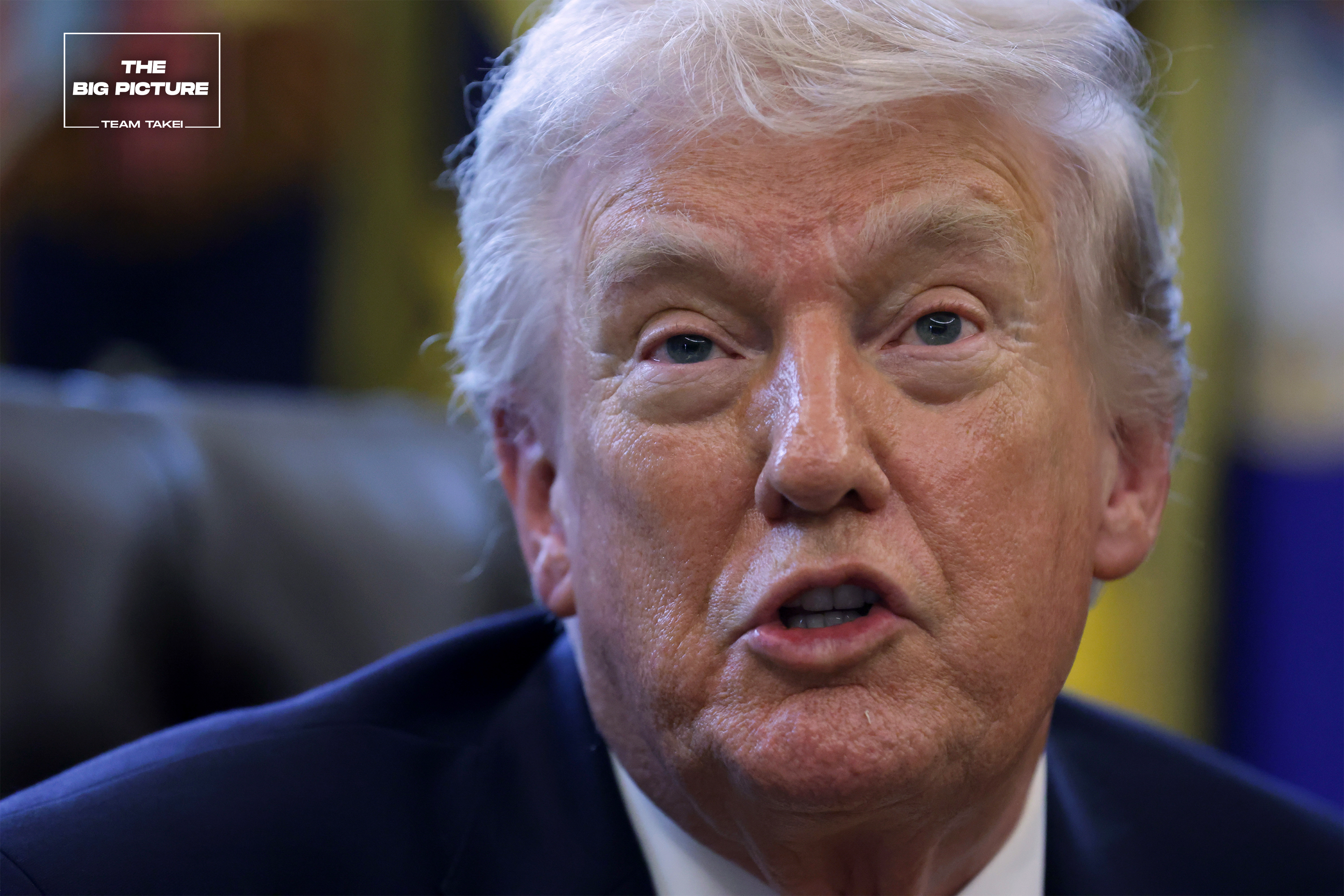
Donald Trump will address the nation about “election fraud” in prime time tonight, and by his own account, the news is “really, really big.”
The speech arrives at a precarious moment for a president who has spent five and a half years building up his false election fraud claims. Some of the legal and legislative tools he hoped to advance that effort are gone: The Supreme Court ruled against him on mail ballots two weeks ago; the DOJ has lost 15 straight times in its attempt to obtain state voter rolls and data; and his SAVE America Act went down to defeat in the Senate on three separate occasions.
Yet Trump takes the podium tonight with the full machinery of the executive branch behind his long-debunked election fraud conspiracy theories. That machinery now includes an intelligence apparatus instructed to hunt for “rigged” election results, a voting-machine oversight board emptied of its members, and perhaps even U.S. forces targeting and capturing those who might falsely “confess” to election interference.
Trump’s prime-time address is scheduled for 9 p.m. ET Thursday. Asked for a preview earlier in the week, Trump offered little beyond the promise of scale: “It doesn’t get bigger, because without free and fair elections, you don’t have a country.” He added, “It will concern that subject, and we’ll have a couple of other things to say also…. We’ll be discussing other things too, but it’s going to be a very big announcement.”
Reporting from Reuters and MS NOW, relayed by Democracy Docket, indicates the address will center on soon-to-be-declassified intelligence material purporting to show irregularities and vulnerabilities in 2020 voting machines. The declassification effort has been led by Bill Pulte, Trump’s acting director of national intelligence. Before taking this job, Pulte led the Federal Housing Finance Agency, where he made criminal referrals against Trump’s political enemies over things like mortgage loan applications. Pulte has no prior intelligence experience, but Trump nevertheless directed him, upon appointment, to investigate “rigged” elections.
Should Trump revisit his claims about 2020 tonight as expected, he will be rehashing one of the most scrutinized elections in American history — one that produced no supporting evidence of fraud from any recount, the U.S. intelligence community, or his own first-term Justice Department.
The timing of the speech suggests it could also serve as a distraction. Trump is watching his ill-fated deal to end the war with Iran collapse in real time, and the regime faces renewed criticism from recent fatal shootings by ICE officers. But the speech could also backfire by making Trump appear focused once again on conspiracies about an election that happened nearly six years ago, rather than the challenges facing ordinary Americans today, including high gas, groceries, housing and utility prices.
Mail-in voting and California
Trump has suffered major legal setbacks lately in his quest to undermine the midterms. In late June, the Supreme Court closed off Trump’s clearest legal path to challenging mail ballots. In a 5-4 ruling in Watson v. Republican National Committee, the justices upheld state laws, including the Mississippi law at issue, that count ballots if postmarked by Election Day, even if received afterward. Justice Barrett wrote for the majority, joined by Chief Justice Roberts and the Court’s three Democratic-appointed justices, saying, “The electorate’s choice is made when voting is complete, not when ballots are received.” Justice Alito dissented, joined by Justices Thomas and Gorsuch, with Justice Kavanaugh joining most of the dissent. Trump called the outcome a “tremendous loss.”
Courts have since handed Trump a second defeat on mail voting. As I covered in The Status Kuo last month, a March executive order directed USPS to withhold ballot delivery from any state that refused to hand over its voter rolls. A proposed USPS rule would have required states to submit voter lists and barcode-matched envelopes before any ballot could enter the mail stream. That rule is now blocked on two fronts: U.S. District Judge Indira Talwani enjoined it for the 24 jurisdictions that sued, finding the president “lacks any authority to compile voter lists for each State,” and U.S. District Judge Emmet Sullivan blocked it nationwide, ruling that it violated a 2021 settlement requiring USPS to prioritize timely delivery of election mail. Both injunctions apply only to this year’s elections, leaving the underlying legal question — and the rule itself — a live issue for future cycles.
Trump’s efforts to force states to turn over their voter rolls have fared no better. His Justice Department sued 30 states and Washington, D.C. demanding their complete, unredacted voter registration rolls, including full names, addresses, driver’s license numbers and partial Social Security numbers.
It’s not going as planned. Every court that has ruled on this DOJ request has gone against it: 15 straight district court losses and, in June, a first appellate defeat at the Sixth Circuit over Michigan’s rolls. Nine of those 15 rulings, including the Virginia and New Mexico decisions that brought the tally to 0-15, came from judges appointed by Republican presidents, with six by Trump himself. U.S. District Judge Stephanie Gallagher, a Trump appointee, wrote in dismissing the Maryland case that “this Court joins every court to have addressed this issue in concluding that [a statewide voter registration list] is not a record or paper that a state must produce to the United States.”
While these rulings are welcome, they have done little to change Trump’s underlying appetite for subverting the midterms. As I also covered in The Status Kuo in June, Trump spent that month building a case specifically against California’s vote count, a pattern that culminated in his walking out of a Meet the Press interview after host Kristen Welker pressed him for evidence of the “cheating” he alleged. The dynamic he was objecting to — the “red mirage” of Republican-leaning Election Day ballots counted first and Democratic-leaning mail ballots counted later — is neither new nor itself evidence of fraud. It is the same dynamic that will shape the California U.S. House races that could decide control of Congress this November. Under new maps drawn following Proposition 50, five Republican-held U.S. House seats are considered competitive heading into November, in a chamber Democrats could flip by gaining just three seats.
Institutional pressure: the EAC purge and Dominion
You’ve probably never heard of the Election Assistance Commission, and that’s how things should have stayed. The EAC is a small, bipartisan federal agency created by Congress in 2002 after the Florida recount debacle in the 2000 presidential election. Its job is to test and certify the voting machines used across the country against federal security standards, and it requires agreement from at least three of its four commissioners, with no more than two from the same party, before it can act. In plain terms, it is the closest thing the federal government has to a referee for the physical machines Americans vote on, and it was deliberately designed so no single party — or single president — could control it alone.
But after last week, the EAC has no commissioners left. Republican Commissioner Don Palmer resigned earlier this year, and on July 9, Trump fired everyone else. Democrats Thomas Hicks and Benjamin Hovland were notified in a two-line email from a White House aide: “On behalf of President Donald J. Trump, I am writing to inform you that your position as Commissioner of the Election Assistance Commission is terminated, effective immediately. Thank you for your service.” Republican Commissioner Christy McCormick was called personally and asked to resign.
Hovland learned of his firing during a work trip to a Missouri election office, and flew home the same day. He described the effect on election administrators as “much more like a death-of-1,000-cuts situation than there’s one particular thing that you’re concerned about.” The White House defended the move by citing the Supreme Court’s recent Slaughter ruling expanding presidential removal power over independent agencies. Michael Waldman, president of the Brennan Center for Justice, called the result predictable: “These removals leave the agency without leadership and unable to carry out its major responsibilities.”
The commissioners were not the only target this year. Reuters reported in May that Kurt Olsen, a White House lawyer tasked with investigating Trump’s 2020 fraud claims, pushed the Commerce Department to consider declaring Dominion Voting Systems, whose machines were used in more than half of U.S. states as of 2024, a national security risk. This revived the debunked theory that the machines ran Venezuelan-controlled code. The effort reportedly reached the point where Commerce officials researched legal grounds for a ban before it stalled for lack of supporting evidence. Notably, Fox News paid Dominion $787.5 million in 2023 to settle a defamation suit over nearly identical claims.
This is not Trump’s first attempt to move against voting equipment by executive fiat. An earlier order directed the EAC to ban voting machines that use barcodes or QR codes for vote counting, with limited exceptions for voters with disabilities; courts blocked its major provisions on the same grounds that have defeated most of his election orders: the Constitution delegates election rulemaking to states and Congress, not the president.
Tin-foil hat time?
Three possibilities remain more speculative than the developments documented above, and they depend on wild and debunked conspiracy claims. That, of course, has never deterred Trump from spreading outright lies about the 2020 election, so they are worth at least mentioning.
The first concerns the machines themselves. With the EAC now emptied of commissioners, election law scholar Michael McDonald has floated a specific possibility, characterized by election law professor Rick Hasen as “plausible,” that Trump could attempt to direct the commission to decertify Dominion machines outright based on spurious claims about their integrity and software. Hasen added that he expects any such move to be challenged in court, with challengers likely to prevail. Whatever declassified intelligence Trump presents Thursday will also need to be squared with his own administration’s prior findings: a March 2021 assessment from the National Intelligence Council, CIA, DHS, FBI and State Department found “no indications that any foreign actor attempted to alter any technical aspect of the voting process in the 2020 elections, including voter registration, casting ballots, vote tabulation, or reporting results.”
The second concerns Georgia. The Washington Reporter, an outlet founded by Republican consultants, claimed Monday, citing an unnamed “well-placed source in Georgia,” that Trump would call Sens. Jon Ossoff and Raphael Warnock “illegitimate” over alleged 2020 fraud. The outlet retracted the specific claim within a day, saying instead that the speech would not focus on Georgia’s 2020 results. Ossoff responded before the walkback, writing, “The failed president, pocketing billions as he drives up prices, is afraid to lose the midterms. So he will reheat debunked election conspiracy theories and tell bizarre new lies to deny his 2020 defeat and attack voting rights.” One troubling fact beneath the speculation is not in dispute: In January, FBI agents raided an election office in Fulton County, Georgia, seizing 2020 election materials. According to an internal memo, hundreds of agents were diverted to the case. Then-Director of National Intelligence Tulsi Gabbard traveled to Atlanta to oversee the execution of the search warrant.
The third claim is one I touched on in The Status Kuo in February. Days before U.S. forces captured Nicolás Maduro of Venezuela, Trump began posting videos reviving the debunked Dominion-Venezuela theory; Maduro was captured days later and now faces narco-trafficking charges in federal court. That timing fed speculation among conservative commentators that Maduro might “confess” to Venezuelan interference in the 2020 election in exchange for leniency. Sean Davis, co-founder of The Federalist, wrote in January, “It’s gonna be wild when Maduro tries to plead to lesser charges by proffering evidence that the 2020 election was stolen.” Ed Martin, the DOJ official heading Trump’s “Election Weaponization” task force, reposted it approvingly.
So where does this leave us?
Trump takes the podium tonight having lost so far on nearly every major front. The courts have blocked his efforts to obtain state voter rolls, the Senate has killed the SAVE America Act three times, and the Supreme Court sided against him on mail ballots.
What he retains is his platform: a prime-time audience with millions willing to believe in his red mirage, an intelligence community he personally directed to find him votes and vindication, and a voting-machine oversight board with no one left to object.
I’ll wait until tomorrow to read what our sane substackers write!
I never watch tRump ramblings & lies (I, like so many others, hate his voice!)
Trump's speech tonight is very old school. Back in the day, when we older folks were kids, TV in the summer consisted mostly of re-runs. I'm guessing that's we're going to get tonight.